Monday, October 4, 2010

Total Hack

Heather (C&L): Kurtz Shortens Maddow's Response to White House Praise - Leaves Out Part Where She Said She'd Still Hold Them Accountable
DOWNLOADS: (11)
Download WMV Download Quicktime
PLAYS: (138)
Play WMV Play Quicktime
Embed

All I can say about this is that Howard Kurtz is a hack. Kurtz pretends he's some arbiter of bias in the media, yet he chose to omit part of what Rachel Maddow said in response to some praise by the White House of herself and Keith Olbermann on MSNBC. Shame on you Howard. The end of her response was actually the most important part, which is where she said they can praise her all they want, but it won't keep her from doing reporting they may not be happy with.

Here's Kurtz's edited version of the clip.

KURTZ: But another cable network got a big wet kiss. Deputy Press Secretary Bill Burton talking about MSNBC: "If you're on the left, if you're somebody like Keith Olbermann or Rachel Maddow, or one of the folks who helps keeps our government honest and pushes and prods to make sure that folks are true to progressive values, then he (the president) thinks that those folks provide an invaluable service."

Rachel Maddow expressed her thanks.

(BEGIN VIDEO CLIP)

RACHEL MADDOW, MSNBC: That was very nice. A nice personal -- very flattering, but it's also nice in the sense that in an election year, it is nice for liberals to hear someone from the Democratic- controlled White House talk about liberals without swearing at them.

(END VIDEO CLIP)

KURTZ: So is this an attempt by the White House to make up with the so-called "professional left," and will attacks on Fox backfire?

And here's the entire transcript of the clip from Rachel's show.

MADDOW: The Democratic politics fairy came to visit us today. And the Democratic politics fairy brought us here at THE RACHEL MADDOW SHOW two gifts. First, a White House spokesman today brought up on a gaggle on Air Force One the issue of those darn liberal cable news hosts on the MSNBC. But he brought us up in order to say something nice about us. This is a nice change.

Spokesman Bill Burton described COUNTDOWN and this program as, quote, “helping to keep our government honest and pushing and prodding to make sure that folks are true to progressive values.” Mr. Burton said the president, quote, “thinks that those folks provide an invaluable service.”

That was very nice. Nice personally. Of course, it‘s very flattering. But it‘s also nice in the sense that in an election year, it is nice for liberals to hear someone from the Democratic-controlled White House talk about liberals without swearing at them. None of that means, of course, that we will stop reporting the news in the way that sometimes makes the Democratically-controlled White House swear at us again, but still very nice.

Rachel Maddow has more journalistic integrity in her little finger than Kurtz does in his entire body. If he'd meant to do any honest reporting on what the White House said about Maddow and her response to that praise, he'd have included her entire statement in the video clip he showed his viewers.

digby:

Read this transcript with Milbank on Reliable Sources with Howard Kurtz trying with everything he has to help Beck avoid responsibility for his rhetoric. What's interesting about it is that Milbank is a Villager in extremely good standing and he is breaking the rules and being quite shrill about a Real American. It's obvious that Kurtz doesn't want him to go where he's going, but he's doing it anyway, in a pretty serious way, which is unusual in itself.

I'm guessing that the difference between them at this point is that Milbank has actually watched Beck.

MEDIA MATTERS: Milbank: Beck is "dangerous," gives "fringe conspiracy theories" a large audience

October 03, 2010 1:44 pm ET

From the October 3 edition of CNN's Reliable Sources:

KURTZ: Beck says a lot of inflammatory things. That's part of his style. You see him as peddling conspiracy theories and talking about Nazis a lot.

MILBANK: Yes. I think over his first 18 months, "Nazis" came up in his show 200 times, "fascists" another 200 times. Poor Goebbels only got two dozen mentions.

But that's a constant them, but it's also the floating of the fringe conspiracies. Even Bill O'Reilly has said he believes that Beck is successful because he's willing to take it about five steps further than O'Reilly is. And that is by going on "Fox & Friends" and saying, "I can't debunk the idea that our federal government, through FEMA, is operating concentration camps in Wyoming."

KURTZ: But he didn't endorse that, but you're saying he raised it.

MILBANK: He said, "I can't disprove it." Then a month later, he gets on the show and said, oh, actually, it turns out those were doctored photos from a North Korean prison.

KURTZ: So he corrected.

MILBANK: He corrected it a month later, after a rather violent incident related to that.

KURTZ: OK. Well, you talk about going too far, and maybe this is related to this.

There was a 2009 murder in Pittsburgh, and allegedly committed by a guy who believes that the New World Order and government are plotting against our citizens. You say in the book, "It goes a bit too far to blame Glenn Beck for this, but Beck's words are inspiring the fringe."

Now, isn't that guilt by association?

MILBANK: Well, except that the people who are committing these acts often mentioned Glenn Beck themselves. We had another case of a guy shooting at the cops out in San Francisco, attempted to blow up the Tides Foundation, which was mentioned on Beck's show.

KURTZ: But what if somebody committed a violent act and said, you know, I read Dana Milbank's columns and I really think -- I'm --

(CROSSTALK)

MILBANK: That's why I say it goes too far to hold him responsible for that. But when you have a guy who's taking, as the Anti-Defamation League says, these fringe conspiracy theories and giving them an audience of, I don't know, 10 million people a week on the radio, nearly three million a night on Fox News, you're elevating something that has always been on the fringe in American politics and putting it front and center. So while you can't be blamed for any individual act, it is evidence that he is disseminating a very dangerous doctrine.

KURTZ: You think he's dangerous?

MILBANK: Well, I think it's been manifestly true that he's dangerous, but he's very powerful as well.

KURTZ: You haven't proven that he's dangerous. You've proven that -- you've argued that he says a lot of things that you don't like.

MILBANK: Well, and when a man is frequently talking about Hitler and Nazis, and then you see the Tea Party rally with the same quotations of Tea Parties and Nazis, the one-world government, the United Nations taking over civilization, posters of Dachau, you have to say, where does all this come from and why is it suddenly out in the open?

So, yes, that's why I think it's dangerous.

KURTZ: So you mentioned his big audience. I mean, he gets a huge number in the afternoon on Fox, radio audience. So what makes him so popular? What do you make of the people who tune in for inspiration?

MILBANK: I think it is just that. I mean, in a country of 310 million people, two million watching him is not a huge number. But it's a huge number -- a small number of very passionate followers.

Now, I mean, I think some of this is he very cleverly speaks to -- he's a Mormon, very cleverly speaks in terms of Mormon prophesy and conspiracy theories. I think that generates some of his audience. And some of it is also out of fear.

He talks about the world is ending. People advertise for vegetable seeds on his show so you can keep it in a locked box, and when the apocalypse comes, you can plant it and grow vegetables in your back yard. He's pushing gold coins. So, his audience is very frightened people who really think the end is coming.

KURTZ: All right. I'll tune in to see whether he talks about Dana Milbank on his show this week.


Friday, October 1, 2010

Just watch it.

Rachel on the end of democracy.

Wednesday, September 29, 2010

"like chum to sharks"

Matt Taibbi: Tea & Crackers -- How corporate interests and Republican insiders built the Tea Party monster

This is an article from the October 15, 2010 issue of Rolling Stone.

It's taken three trips to Kentucky, but I'm finally getting my Tea Party epiphany exactly where you'd expect: at a Sarah Palin rally. The red-hot mama of American exceptionalism has flown in to speak at something called the National Quartet Convention in Louisville, a gospel-music hoedown in a giant convention center filled with thousands of elderly white Southerners. Palin — who earlier this morning held a closed-door fundraiser for Rand Paul, the Tea Party champion running for the U.S. Senate — is railing against a GOP establishment that has just seen Tea Partiers oust entrenched Republican hacks in Delaware and New York. The dingbat revolution, it seems, is nigh.

"We're shaking up the good ol' boys," Palin chortles, to the best applause her aging crowd can muster. She then issues an oft-repeated warning (her speeches are usually a tired succession of half-coherent one-liners dumped on ravenous audiences like chum to sharks) to Republican insiders who underestimated the power of the Tea Party Death Star. "Buck up," she says, "or stay in the truck."

Stay in what truck? I wonder. What the hell does that even mean?

Scanning the thousands of hopped-up faces in the crowd, I am immediately struck by two things. One is that there isn't a single black person here. The other is the truly awesome quantity of medical hardware: Seemingly every third person in the place is sucking oxygen from a tank or propping their giant atrophied glutes on motorized wheelchair-scooters. As Palin launches into her Ronald Reagan impression — "Government's not the solution! Government's the problem!" — the person sitting next to me leans over and explains.

"The scooters are because of Medicare," he whispers helpfully. "They have these commercials down here: 'You won't even have to pay for your scooter! Medicare will pay!' Practically everyone in Kentucky has one."

A hall full of elderly white people in Medicare-paid scooters, railing against government spending and imagining themselves revolutionaries as they cheer on the vice-presidential puppet hand-picked by the GOP establishment. If there exists a better snapshot of everything the Tea Party represents, I can't imagine it.

After Palin wraps up, I race to the parking lot in search of departing Medicare-motor-scooter conservatives. I come upon an elderly couple, Janice and David Wheelock, who are fairly itching to share their views.

"I'm anti-spending and anti-government," crows David, as scooter-bound Janice looks on. "The welfare state is out of control."

"OK," I say. "And what do you do for a living?"

"Me?" he says proudly. "Oh, I'm a property appraiser. Have been my whole life."

I frown. "Are either of you on Medicare?"

Silence: Then Janice, a nice enough woman, it seems, slowly raises her hand, offering a faint smile, as if to say, You got me!

"Let me get this straight," I say to David. "You've been picking up a check from the government for decades, as a tax assessor, and your wife is on Medicare. How can you complain about the welfare state?"

"Well," he says, "there's a lot of people on welfare who don't deserve it. Too many people are living off the government."

"But," I protest, "you live off the government. And have been your whole life!"

"Yeah," he says, "but I don't make very much." Vast forests have already been sacrificed to the public debate about the Tea Party: what it is, what it means, where it's going. But after lengthy study of the phenomenon, I've concluded that the whole miserable narrative boils down to one stark fact: They're full of shit. All of them. At the voter level, the Tea Party is a movement that purports to be furious about government spending — only the reality is that the vast majority of its members are former Bush supporters who yawned through two terms of record deficits and spent the past two electoral cycles frothing not about spending but about John Kerry's medals and Barack Obama's Sixties associations. The average Tea Partier is sincerely against government spending — with the exception of the money spent on them. In fact, their lack of embarrassment when it comes to collecting government largesse is key to understanding what this movement is all about — and nowhere do we see that dynamic as clearly as here in Kentucky, where Rand Paul is barreling toward the Senate with the aid of conservative icons like Palin.

Early in his campaign, Dr. Paul, the son of the uncompromising libertarian hero Ron Paul, denounced Medicare as "socialized medicine." But this spring, when confronted with the idea of reducing Medicare payments to doctors like himself — half of his patients are on Medicare — he balked. This candidate, a man ostensibly so against government power in all its forms that he wants to gut the Americans With Disabilities Act and abolish the departments of Education and Energy, was unwilling to reduce his own government compensation, for a very logical reason. "Physicians," he said, "should be allowed to make a comfortable living."

Those of us who might have expected Paul's purist followers to abandon him in droves have been disappointed; Paul is now the clear favorite to win in November. Ha, ha, you thought we actually gave a shit about spending, joke's on you. That's because the Tea Party doesn't really care about issues — it's about something deep down and psychological, something that can't be answered by political compromise or fundamental changes in policy. At root, the Tea Party is nothing more than a them-versus-us thing. They know who they are, and they know who we are ("radical leftists" is the term they prefer), and they're coming for us on Election Day, no matter what we do — and, it would seem, no matter what their own leaders like Rand Paul do.

In the Tea Party narrative, victory at the polls means a new American revolution, one that will "take our country back" from everyone they disapprove of. But what they don't realize is, there's a catch: This is America, and we have an entrenched oligarchical system in place that insulates us all from any meaningful political change. The Tea Party today is being pitched in the media as this great threat to the GOP; in reality, the Tea Party is the GOP. What few elements of the movement aren't yet under the control of the Republican Party soon will be, and even if a few genuine Tea Party candidates sneak through, it's only a matter of time before the uprising as a whole gets castrated, just like every grass-roots movement does in this country. Its leaders will be bought off and sucked into the two-party bureaucracy, where its platform will be whittled down until the only things left are those that the GOP's campaign contributors want anyway: top-bracket tax breaks, free trade and financial deregulation.

The rest of it — the sweeping cuts to federal spending, the clampdown on bailouts, the rollback of Roe v. Wade — will die on the vine as one Tea Party leader after another gets seduced by the Republican Party and retrained for the revolutionary cause of voting down taxes for Goldman Sachs executives. It's all on display here in Kentucky, the unofficial capital of the Tea Party movement, where, ha, ha, the joke turns out to be on them: Rand Paul, their hero, is a fake.

Think Progress: TenMillionVoters.Com: Newt Launches Tea Party Campaign To Stop ‘Radical, Secular Socialist Machine’ »

With the incendiary claim that the Obama presidency is the greatest threat the American people have ever faced, Newt Gingrich has launched a massively funded effort to mobilize ten million conservative voters this November. In an online video promoting the “Power of 10” campaign by his American Solutions for Winning the Future (ASWF) 527 group, Gingrich rails against the “genuinely radical, secular socialist machine” of the “Obama-Pelosi-Reid team” who “simply run over the beliefs and values of the American people.” Images of Tea Party rallies and the right-wing enemies list — Michael Moore, Sean Penn, and Katie Couric — scroll by as Gingrich pleads for “we the American people” to “go all out”:

You know, I don’t remember any time in American history where we had such a threat to our basic way of life: A genuinely radical, secular socialist machine ramming things through with no regard for American values or the beliefs of the American people.

Watch it:

American Solutions for Winning the Future is bankrolled by a cadre of the right-wing billionaires and oil and coal companies who put George W. Bush into office and destroyed the national economy.

Read more about Newt Gingrich’s ASWF at the Wonk Room.


Tuesday, September 28, 2010

Hell on Earth

QOTD: Dennis G.
This core myth—that the American Government is the enemy—is at the heart of the rhetoric, talking points, spin and bullshit of wingnutopia these days. It is an old-time core belief of the Confederacy as well. The recently released ‘pledge’ is a document anchored in a Confederate understanding of how America should function. So is the question of taxes or health care reform or infrastructure spending or education or protecting workers or whatever. Time and time again the effort is to replace the notion that a central government is a legitimate center of power with a belief that each state has the right to do whatever it wants to do regardless of any Federal mandates (unless of course a State wants to do something that might threaten a Confederate power base like free slaves or fight climate change). This notion that the central government must be kept weak is rooted in an elitist understanding of Liberty—the Confederate belief that Constitutional Liberty is based on protection of property and not based on individual rights. For some reason, the concept of individual Liberty fills Confederates—old and neo—with a sense of dread.
Benen: A 'UNILATERAL DECISION TO END LEGISLATIVE ACTIVITY IN THE SENATE'
Stan Collender speculated over the weekend that Senate Republicans may very well try to shut down the pre-adjournment legislative schedule, and possibly even try to shut down the government, this week. As it turns out, Collender was onto something. Roll Call reports on a new GOP scheme that the newspaper accurately describes as "remarkable."

Sen. Jim DeMint warned his colleagues Monday night that he would place a hold on all legislation that has not been "hot-lined" by the chamber or has not been cleared by his office before the close of business Tuesday. [...]

Traditionally, the Senate passes noncontroversial measures by unanimous consent at the end of most workdays, a process known as hot-lining. DeMint, Sen. Tom Coburn (R-Okla.) and others have fought against the practice for years and have dedicated staff members to reviewing bills that are to be hot-lined.

As a result, Senate Majority Leader Harry Reid (D-Nev.) and Minority Leader Mitch McConnell (R-Ky.) have generally given DeMint, Coburn and others time to review legislation before proceeding with unanimous consent agreements.

But in a terse e-mail sent to all 100 Senate chiefs of staff Monday evening, Steering Committee Chief of Staff Bret Bernhardt warned that DeMint would place a hold on any legislation that had not been hot-lined or been cleared by his office before the close of business Tuesday.

Roll Call added that aides from both parties were "stunned" by DeMint's stunt, which effectively amounts to "a unilateral decision to end legislative activity in the Senate." If he doesn't personally approve of a measure, DeMint will kill it.

The Senate is still coming to terms with the practical implications, since the chamber was set to adjourn anyway on Thursday. But the Senate is set to consider, among other things, a "cloture motion to begin debate on a continuing resolution to keep the government funded when the new fiscal year begins Oct. 1."

In other words, senators may have to scramble to craft "a stopgap spending measure to keep the government operating past Sept. 30," and the death of several "non-controversial bills that both parties are looking to clear before Election Day."

David Dayen has more on DeMint's "one-man government shutdown," including some procedural insights from David Waldman.

Heather (C&L): Republicans Block Oil Spill Commission From Having Subpeona Powers
The Republicans really just have no shame. The Democrats asked for unanimous consent in the Senate to pass legislation that would give the BP Oil Spill Commission subpoena power -- and surprise, surprise! Guess who stood up for them and objected? Wingnut Teabagger King Jim DeMint. Republicans don't want BP executives or any of the rest of them to have to testify under oath.

I'd be surprised if that commission was going to yield any news we haven't already heard anyway from those executives who did nothing but stonewall the last time they testified before a Congressional committee, but it looks like the Republicans don't want to take any chances and assure the committee will be toothless.

Sullivan: The Foundation Obama Has Already Quietly Built, Ctd

David Hume, from the right, agrees with Andrew Sprung that President Obama has already won regardless of what happens in November:

After the likely losses in the fall the pundits will talk about what Obama needs to do to win back the nation, etc. But the fact is that he’s already changed the nation, by shifting healthcare policy in a direction broadly consonant with liberal Democratic values. That’s really what matters, and what will echo down through the generations. The Democratic victories of 2006 will be forgotten very soon, and to some extent those of 2008 will be too. But the policies enacted by the Congress of 2008 will impact us in our day to day lives for generations. They already are.

I don’t begrudge the Republicans their exultation after their likely victory in November. But this isn’t professional sports, it’s more than just a game, and it’s even more than just an avenue for professional advancement and self-glorification. Winning isn’t everything; it’s just a vanity which appeals to our baser animal instincts.

That's ignoring financial re-regulation, the isolation of Iran, and the social revolutions on marijuana and marriage equality that have accelerated under his watch. I think the debt commission may be the next substantive, long-term victory (I certainly hope so). Then there is the way in which GOP victories will come at the expense of profound alienation by Latinos, and the abandonment of the GOP by the professionel elites, recoiling from the party of Palin, Beck and O'Donnell.


Benen: HOUSE GOP PREPARES ANTI-CLIMATE CRUSADE
A couple of months ago, Rep. Michele Bachmann (R-Minn.) the main thing House Republicans should focus on, if they take back the majority, is launching endless investigations. "I think that all we should do is issue subpoenas and have one hearing after another, and expose all the nonsense that has gone on," she said in July.

In context, Bachmann was largely referring to the White House, but some of her House colleagues intend to pursue a very similar course, and include global warming among the "nonsense."

One leading far-right Republican said last week that attacking science would be near the top of his to-do list.

The House's top Republican watchdog is planning to launch an investigation into international climate data if he takes the helm of the chamber's oversight panel next year.

Rep. Darrell Issa (R-Calif.), the ranking member of the Oversight and Government Reform Committee, said a probe of the "Climategate" scandal will top his environmental agenda if the Republicans take over the House next year and he gets the chairmanship. [...]

Investigative panels in Britain and the United States have since cleared researchers of any wrongdoing, but some Republican lawmakers remain unconvinced.

Jim Sensenbrenner, meanwhile, is prepared to play the role of Tweedledee to Issa's Tweedledum.

Most House Republicans envision killing Nancy Pelosi's special global warming committee if they claw their way back into the majority this November.

But one senior GOP lawmaker has another idea in mind: sweet revenge.

Wisconsin Rep. Jim Sensenbrenner wants to keep the Select Committee on Energy Independence and Global Warming alive so it can investigate climate science and police President Barack Obama's green policies.

The Politico piece suggests there may be some simmering intra-party hostility between the two right-wing lawmakers -- they each want to take the lead in going after science and environmental policy -- but the point is they're both going to be launching anti-climate crusades.

When we think about what to expect from House Republicans when it comes to investigations, we tend to think of comparisons to Clinton-era witch-hunts. And to be sure, we're very likely to see exactly that -- as Paul Krugman recently noted, "[W]e'll be having hearings over accusations of corruption on the part of Michelle Obama's hairdresser, janitors at the Treasury, and Larry Summers's doctor's dog."

But it's also worth remembering that when the GOP isn't making up nonsense about the White House, it'll be holding ridiculous hearings and launching baseless investigations into other far-right obsessions, too.

Dennis G: Gimmie that old-time tactic…

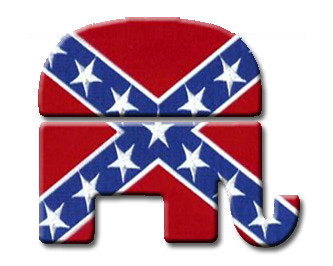
ConfederateGOP Logo

The overlap between the modern self-described “conservative” movement (from teatards to wingnuts to blowhards to GOPers) and the old Confederate movement from 150 years ago is stunning. Especially when one digs into the framing, memes, rhetoric and philosophical underpinnings of both movements. This is really just the latest iteration of a movement in America that can not accept defeat and that does not believe in any compromise. It is a movement that offers the rest of us only a choice between capitulation or gridlock. And it is a movement that keeps the threat of violence at hand to intimidate folks to meet their endless demands.

The biggest shared element between the Teatard/Wingnut denizens of the modern Republican Confederate Party is the tactic of “NO”. The firm dedication to only offer the rest of the Nation a binary choice between capitulation or gridlock, complete surrender or violence (“Nice Country you have here, it would be a shame if anything were to happen to it…”). This is the golden thread that connects this neo-Confederate movement to their real Founding Fathers of 1860.

In 1859 the Confederates had won a series of major political battles through a tactic of always rejecting any compromise short of absolute capitulation to their demands. From time to time a ‘compromise’ was accepted by the Confederates, but before the ink was dry on any agreement they moved the bar and demanded a fresh capitulation as the price to end their latest temper tantrum. Through their control of the Supreme Court they had basically won the right to extend slavery to any territory of the United States and still there were Democrats and old Whigs throughout the North who favored more capitulations thinly disguised as compromise. Finally a majority had enough of this shit and elected Lincoln. The Confederates had a hissy fit and went out and then the War came.

Before 1860 there were decades of Confederates demanding an endless series of capitulations from the rest of the Country. Early on, back in the 1820s through the 1850s, they mostly threatened the Nation with gridlock (unless you were black, lived in Kansas or were an Abolitionist Senator from Massachusetts—then it was violence). Decade after decade, almost every story in American politics could be boiled down to a tale of the rest of the Country finding a way to compromise with Confederate extremists and their never ending series of demands. Through it all, time and time again, it came down to a choice: surrender or gridlock, capitulation or violence. This is the go-to Confederate tactic of “NO”. And this is still the core tactic of the current crop of neo-Confederates who once again are tying to hold this Nation hostage to the demands of their rich fantasy lives.

The Teatard/Wingnut rhetoric about the Founding Father and the Constitution is NOT an American reading of history, instead it is a Confederate understanding of history firmly rooted in Confederate rhetoric, philosophy and framing. Of course owning up to their Confederate roots might get some bad press, so it must be hidden. “Confederacy” is the name of their movement that does not dare to reveal itself and so they cover up their Confederate roots as best they can—going to crazy leaps of logic and twists of history to pretend that their old-time CSA values are actually USA values. And yet they can not hide from themselves. The old Confederate arguments and tactics keep bubbling to the surface.

the rest of this essay is at the link.

Benen: PENCE'S CONFUSION KNOWS NO BOUNDS
I'm always glad when Matt Yglesias writes about House Republican Conference Chairman Mike Pence (R-Ind.). The well deserved repulsion just bleeds through the screen.

Last year, Matt had an item that explained "Mike Pence is a moron, and any movement that would hold the guy up as a hero is bankrupt.... I would refer you to this post from September about the earth-shattering ignorance and stupidity of Mike Pence.... [I]t's really staggering. In my admittedly brief experience talking to him, his inability to grasp the basic contours of policy question was obvious and overwhelming."

Today, Matt flags another Pence gem, reminding us that the House GOP Conference Chairman "gives every indication of being genuinely stupid."

GRETA VAN SUSTEREN: Why can't we [sell health insurance across state lines]?

MIKE PENCE: Well, it's really lost on me. I remember having a conversation with former senator Tom Daschle, who was really instrumental in the crafting and passage Obamcare, saying we couldn't sell insurance across state lines because it would be a "race to the bottom." Well, I gotta tell you, I think a lot of small business owners out there would like a race to the bottom -- on prices.

Even after a lengthy debate on this, Mike Pence still doesn't have the foggiest idea what he's talking about. When he says this issue is "really lost on me," that's clearly the truth.

We've been through this enough times that even a House Republican should be able to understand it. Different states regulate insurers in different ways, with restrictions ranging from strict to weak. As the GOP sees it, the model can and should follow the credit card industry standards -- let all the major insurers cluster in one state where the standards are barely existent.

It's why this idea is generally characterized as promoting a "race to the bottom." Insurers would be told that they can set up shop in a state and write the rules to the industry's liking. The industry would go with the state that offered the sweetest deal -- which is to say, the worst, weakest, most lax oversight with the fewest restrictions -- and before long, it would be consumers' only choice. Why? Because every major insurer would move to that state, leaving Americans with no other coverage to buy.

The insurance, under this approach, would probably be cheaper. It will also be awful. Pence may not care -- you and I already pay for his health insurance and that of his family -- and may even see this as preferable to the status quo, but the rest of us would suffer.

In the Affordable Care Act, President Obama offers a better approach, which allows insurers to sell coverage across state lines, just so long as they meet minimum federal standards. It's these standards that prevent the race to the bottom. When Obama offered this as a compromise a year ago to Republicans, they balked, insisting that minimum standards would mean federal regulations imposed on insurance companies. And we can't have that because it would mean government looking out for consumers, which is, you know, bad. Or something.

Democrats included the provision in the new law anyway, and insurers in states willing to operate under minimum standards can, in fact, sell coverage across state lines. (When Greta Van Susteren asks why we can't do this, she apparently doesn't know what the law says, either.)

Unfortunately for Pence, policy tutoring isn't covered in any plan, and profound ignorance is considered a pre-existing condition.

Yglesias: Poor People Are Much Poorer Than You Think

Via Tim Noah, a striking chart from Daniel Ariely and Michael I. Norton’s paper (PDF) “Building a Better America One Wealth Quintile at a Time”:

Real vs. Imagined Wealth Distribution in the U.S 1

Actual represents the actual distribution of wealth. Estimated is what people think the distribution of wealth is. I agree with Noah that the methodology that generated the “ideal” numbers is a bit odd so I’ll ignore it.

Both Noah and Ariely & Norton focus on what this shows us about the top twenty percent, but I don’t think that’s news. We already know from polling that the median voter supports “soak the rich” tax policies far beyond what the right people who run the Democratic Party are prepared to propose. What’s interesting here is the extent to which the public vastly overestimates the prosperity of lower-income Americans. The public thinks the 4th quintile has more money than the median quintile actually has. And the public thinks the 5th quintile has vastly more wealth than it really has.

You can easily see how this could have a giant distorting effect on our politics. Poor Americans are simply much, much, much needier than people realize and this is naturally going to lead to an undue slighting of their interests.

Benen: KRISTOL OFFERS A PREVIEW OF WHAT'S TO COME
When it comes to journalistic standards, policy understanding, political prognostications, and basic human decency, I don't consider Bill Kristol an especially credible figure. But his sources in Republican politics tend to be pretty solid, so when he talks about what Americans expect from the GOP next year, it's worth taking him at least a little seriously.

Here, for example, was an exchange on "Fox News Sunday" yesterday about the widely-panned "Pledge with America" pseudo-agenda presented Thursday by House Republican leaders.

KRISTOL: It's a step on the way to boldness. I mean, seriously, if a power drunk, inebriated, big government-loving Democratic Party is driving the car off the cliff, the first responsibility is to put on the brakes. I think the Republicans are absolutely right about that. Stop the bad policies, go back to 2008 levels of discretionary spending, that's a pretty big cut, as you pointed out in your interview with Republican leaders. That's a pretty big cut in current discretionary spending.

WALLACE: Nothing about earmarks, nothing about entitlements.

KRISTOL: There are not gonna be earmarks next year. They can't get all their caucus to agree to it now, but if Republicans take the House, there will be such sentiment of the Tea Party nation that they will not, in my view, do earmarks. They will really cut discretionary spending. Paul Ryan will lay down the budget on April 1st, 2011, as chairman of the Budget Committee, that will address entitlements. They're being reasonable; they're being bold in a reasonable way.

First, "putting on the brakes" when Democrats are finally dragging the car out of the ditch Republicans left us in seems like a bad idea. At the risk of straining the metaphor, if hitting the gas helped end the recession and started adding jobs again, why would Republicans want to slam on the brakes?

Second, going "back to 2008 levels of discretionary spending" would lead to drastic cuts to education and essential public services -- the kind of cuts that would hurt working families at a time when the economy is already struggling.

Third, if there are "not gonna be earmarks next year," there's no reason why GOP leaders felt compelled to leave this out of their plan.

And fourth, if Paul Ryan "addresses entitlements," he's going to slash Social Security and Medicare with devastating consequences. That's his plan -- he's put in writing.

Kristol might as well been offering a testimonial on behalf of Democrats -- vote GOP in November and the country will go back to Bush-era economic policies, coupled with drastic cuts to education, Social Security, and Medicare. That's not some liberal making the case; that's Bill Kristol telling Fox News how it's going to be.

Democrats miss the national forest for the local trees
Rachel Maddow notes that while Republican candidates like Christine O'Donnel and Joe Miller have made their campaigns national, raising money through Fox News and other national outlets, their Democratic counterparts are running small, local races.

Visit msnbc.com for breaking news, world news, and news about the economy

Greg Sargent

* The GOP's massive midterm advantage: Important read of the morning: The Associated Press fleshes out the details of the lopsided, six-to-one edge right wing groups enjoy over the left as they flood the midterm elections with outside cash.

Key takeaway: While the huge amount of right-wing money is making up for the fundraising lag of the GOP party committees, it's also forcing Dem committees to spend more money earlier that they'd hoped to keep stockpiled for the final stretch. Read the whole thing.

* But those poor billionaires and corporations are just terrified of the left's wrath: Former RNC chair Ed Gillespie, a leader of non-transparent efforts to flood the midterm elections with corporate cash, says conservative donors deserve to remain anonymous so they can avoid persecution from the left.

* Another Senate race in play? A new Quinnipiac poll finds wrestling exec Linda McMahon rapidly closing the gap with Connecticut Attorney General Richard Blumenthal in the race for a seat that national Dems assumed was safe. And Taegan Goddard notes that multiple other polls show the same.

But: In a sign of how worried the Blumenthal camp is about the come-from-behind narrative, his campaign rushes out a polling memo insisting he has a 12-point lead.

* Are things looking up for Dems in the House? Chris Cillizza explains why Dems are quietly growing a bit more optimistic.

One thing I would add: Dems argue that they are fielding stronger, better-prepared candidates than the GOP in multiple districts, an edge that would not register in national generic ballot matchup polling and could assert itself in a district-by-district sense when voters begin focusing on their choices in earnest.

* Takedown of the day: "Profiles in timidity." The New York Times edit board skewers skittish Congressional Dems for punting on the Bush tax cut vote -- and, crucially, whacks Dems for blaming their own spinelessness on the obstructionism of those mean and nasty Republicans.

* Special bonus takedown of the day: Kathleen Sebelius takes to the pages of the Wall Street Journal to skewer the ludicrous right-wing assault on her earlier demand that insurance companies avoid unjustified rate increases, which right wingers likened to "Soviet tyranny" and "thuggery."

* Random question: If the liberal groups staging a big rally on the Mall this Saturday get decent turnout, will it get anywhere near the coverage routinely lavished on Tea Party rallies that fall well short of turnout goals? No, there won't be any outsized three-corner hats or batsh*t insane signs, but still...


GOP candidate pines for robber baron days
Rachel Maddow reports on West Virginia Republican Senate nominee John Raese's pride at having inherited his wealth and his desire to return to an era of worker exploitation.

Visit msnbc.com for breaking news, world news, and news about the economy


Benen: THE TALKING POINT I'M STILL WAITING TO HEAR
On "This Week" yesterday, Senate Minority Leader Mitch McConnell (R-Ky.) said we can't raise anyone's taxes "in the middle of a recession." He liked the phrase so much, McConnell used it four times during the interview.

It's a weak argument. For one thing, we're not in the middle of a recession. For another, most economists agree that allowing the wealthy to start paying Clinton-era top marginal rates again would have little, if any, effect on the economy. (In recent decades, both Reagan and Clinton raised taxes during difficult economic times, and both saw the economy grow soon after.)

But putting all of that aside, there's one talking point that happens be true, but which is seldom repeated: we shouldn't cut spending during difficult economic times, either. The flip side -- tax increases during tough times is outrageous -- is ubiquitous, but this talking point is generally nowhere to be found.

I found this exchange between McConnell and Christiane Amanpour both fascinating and painful.

AMANPOUR: [T]here's also this huge thing that the people of the United States are worried about, and that is the deficit.... and keeping the tax cuts will add trillions to that. And let me ask you this. According to Howard Gleckman at the Tax Policy Center -- let's see what he's just written -- "McConnell would have to abolish all the rest of the government to get a balance by 2020, everything. No more national parks, no more NIH, no more highway construction, no more homeland security, oh, and no more Congress."

MCCONNELL: Let me tell you how I'd reduce the deficit. There are two things you need to do. Number one, you need to get spending down, and number two, we need to get the economy going.

In McConnell's mind, taking money out of the economy during a difficult time would make the economy stronger. And why does he think that makes sense? He didn't say, but he went on to argue:

MCCONNELL: Everything that's happened in the last year-and-a-half has been to pump up the government. We borrowed stimulus money. We spent it to hire new federal government workers. We sent it down to states so they would not have to lay off state workers. You have to get the economy going.

I realize McConnell's understanding of this is limited, but it's really not that complicated. We used public resources to create millions of jobs, and save many more workers who would have been laid off. They, in turn, had money to spend and invest, which then contributed to broader growth. It's why the economy started growing last year, and why the economy has added 763,000 private-sector jobs just this year.

As McConnell sees it, the U.S. economy would be better off if those millions of Americans had lost their jobs, and not had income to spend. That's how we "get the economy going."

I realize there are Americans who find this persuasive. I have no idea why.

  • from the comments:

    I heard Limbaugh just last week "explaining" again how cutting taxes increases revenues. The mother of all zombie lies and there are enough people who believe it to keed McConnell and his ilk in government jobs for the rest of their lives.

    Posted by: martin on September 27, 2010 at 9:07 AM

Saturday, September 25, 2010

What digby & Rachel said . . .

Digby: NY Times Miss Manners Hints At Truth
The New York Times features an interesting story this morning about a move across teh country to remove judges by people who don't like their decisions:

After the State Supreme Court here stunned the nation by making this the first state in the heartland to allow same-sex marriage, Iowa braced for its sleepy judicial elections to turn into referendums on gay marriage.

The three Supreme Court justices on the ballot this year are indeed the targets of a well-financed campaign to oust them. But the effort has less to do with undoing same-sex marriage — which will remain even if the judges do not — than sending a broader message far beyond this state’s borders: voters can remove judges whose opinions they dislike.

Around the country, judicial elections that were designed to be as apolitical as possible are suddenly as contentious as any another race.

In Kansas, anti-abortion activists are seeking to recall a justice. In Illinois, business interests are campaigning against the chief justice after a case that removed a cap on malpractice liability, prompting him to run a television ad that opens with the declaration, “I am not a politician.” And a conservative group called Clear the Bench Colorado is citing a host of decisions in seeking to oust the full slate of justices on the ballot there, urging voters, “Be a citizen, not a subject.”


It goes on to point out that the laws many of them were using were designed to remove corrupt or incompetent judges but are now being used to send a message that judges who do not adhere to certain views will be kicked out of office.

It also points out that there is big money involved, with the campaigns being underwritten by corporate interests and wealthy Christian groups.

But they forgot to connect the dots in this story. Do you notice something that all these cases around the country have in common? Yes, I knew that you could -- they are all being waged by right wingers. This "trend" is decidedly one-sided, run by a minority faction in America who have decided that their interpretation of the laws and the constitution will be imposed upon everyone.

Far be it for me to suggest that intimidating judges and replacing ones you don't like with social conservatives might be just a little bit theocratic and surely nobody can believe thatcorporate sponsored removal campaigns are designed to make it impossible for moderate or conservative judges to compete against business friendly judges. It would be very impolite to point any of that out, which is why, I'm sure that the New York Times didn't bother to do it.

They simply left some little hints for the discerning reader to sift through:

Brian S. Brown, executive director of the National Organization for Marriage, which has spent $230,000 on television ads criticizing the Iowa judges, said he understood that removing the three judges would not change the same-sex marriage ruling. (It was a unanimous ruling by the state’s seven justices.) But Mr. Brown said he hoped the judges’ ouster would help prevent similar rulings elsewhere by making judges around the nation aware that their jobs are on the line.

“It sends a powerful message,” he said, “That if justices go outside the bounds of their oaths, if the justices go outside the bounds of the U.S. and state constitutions they’re going to be held accountable.”

Bob Vander Plaats, who made opposition to same-sex marriage a centerpiece of his unsuccessful run for governor in Iowa, is leading the ouster campaign on behalf of the political arm of the American Family Association, a conservative Christian organization based in Tupelo, Miss.

“My bigger fear isn’t about injecting politics into judicial retention elections. The bigger fear is that we don’t hold them in check,” he said, warning that gun and property rights could be at risk.


Make of that what you will dear reader. But never say that the NY Times stooped to the level of shrill bloggers who suggest that the far right might have a radical agenda. Let no one say that the old Gray Lady is anything but well mannered.

DADT opponents find ally in Constitution


Jonathan Turley, Constitutional law professor at George Washington University Law School, talks with Rachel Maddow about Friday's ruling against "Don't ask, don't tell, the Witt standard, and the recent space of gay rights wins in court cases around the country.

Visit msnbc.com for breaking news, world news, and news about the economy


Billionaires pump money into GOP campaigns


Rachel Maddow shares a report that 91 percent of the money contributed to a Republican group tied to Karl Rove came from just three billionaires. Chris Hayes of The Nation magazine joins to discuss the drastic inequality in income and influence in America.

Visit msnbc.com for breaking news, world news, and news about the economy

Thursday, September 23, 2010

Wednesday, September 22, 2010

Sigh.

Krugman: Who You Gonna Believe?

I went through my mail today, and got the usual batch of letters declaring that I’m wrong about everything, and that we should do the opposite of anything I say. Hey, it’s a free country.

But I found myself wondering, as I often do, about the determination with which people believe pundits who please them ideologically, no matter how wrong they have repeatedly been — wrong in ways that, if you believed them, cost you money.

Suppose you had spent the last five years actually believing what you read from the usual suspects — the WSJ opinion pages, National Review, right-wing economists, etc.. Here’s what would have happened:

In 2006 you would have believed that there was no housing bubble.

In 2007 you would have believed that the troubles of subprime couldn’t possibly spread to the financial system as a whole.

In 2008 you would have believed that we weren’t in a recession — and that the failure of Lehman was unlikely to have bad consequences for the real economy.

In 2009 you would have believed that high inflation was just around the corner.

At the beginning of 2010 you would have believed that sky-high interest rates were just around the corner.

Now, we all make mistakes and get things wrong — although it’s striking how often the trolls on this blog feel the need to accuse yours truly of saying things I didn’t. But after this string of errors, wouldn’t you at least begin to suspect that the people you find congenial have a fundamentally wrong-headed view of how the world works?

Guess not.

Ezra Klein: Obama on corporate advertising

The president's most recent radio address was focused on the aftermath of the Citizens United decision and the Republican filibuster against the Disclose Act that would force corporations to take responsibility for their political advertisements. But it ends on an oddly plaintive, almost fearful, note:

What is clear is that Congress has a responsibility to act. But the truth is, any law will come too late to prevent the damage that has already been done this election season. That is why, any time you see an attack ad by one of these shadowy groups, you should ask yourself, who is paying for this ad? Is it the health insurance lobby? The oil industry? The credit card companies?

But more than that, you can make sure that the tens of millions of dollars spent on misleading ads do not drown out your voice. Because no matter how many ads they run – no matter how many elections they try to buy – the power to determine the fate of this country doesn’t lie in their hands. It lies in yours. It’s up to all of us to defend that most basic American principle of a government of, by, and for the people. What’s at stake is not just an election. It’s our democracy itself.

A lot more people will see ads funded by corporations this November than will ever hear or read a word of this radio address.

Benen: THE DRIVE TO BREAK FROM FORCED NEUTRALITY
Peter Goodman, who's been a rising star at the New York Times, covering the economy and business news, agreed this week to leave the paper and sign on with the Huffington Post. Goodman's move, a coup for the online outlet, is a reminder about just how serious a media powerhouse HuffPost is becoming.

But what seemed especially interesting about this wasn't the transition, but rather, the motivation behind it. Goodman chatted with Howard Kurtz about his reasoning.

"For me it's a chance to write with a point of view," Goodman says in an interview. "It's sort of the age of the columnist. With the dysfunctional political system, old conventional notions of fairness make it hard to tell readers directly what's going on. This is a chance for me to explore solutions in my economic reporting."

Goodman, who spent a decade at The Washington Post before his three years at the Times, says he will still rely on facts and not engage in "ranting." And while he was happy at the newspaper, he says, he found he was engaged in "almost a process of laundering my own views, through the tried-and-true technique of dinging someone at some think tank to say what you want to tell the reader."

It's been one of the most glaring flaws in major American media for far too long -- news outlets can tell the public about a story, but they won't tell the public's who's right. Every story has to offer he-said/she-said coverage, and every view has to be treated as entirely legitimate. ("Republicans today said two plus two equals five; Democrats and mathematicians disagree.")

To tell news consumers about a controversy is fine. To tell news consumers who's objectively correct is to be "biased."

For the public that wants to know who's right, and not just who's talking, it creates a vacuum filled by online outlets. For journalists who want to "tell readers directly what's going on," it creates an incentive to abandon news organizations that demand forced neutrality.

brooklynbadboy (Dkos): The wrong way to answer Ms. Velma Hart

First Read noted something that was obvious to me watching the President's town hall:

What was captivating about yesterday’s CNBC town hall with President Obama is that it gave voice -- from real people -- to the reason why his party faces the possibility of big losses on Election Day, which is now exactly six weeks away. That reason: His supporters aren’t fired up right now. “Quite frankly, I'm exhausted,” said one questioner. “Exhausted of defending you, defending your administration, defending the man for change I voted for, and deeply disappointed with where we are right now.”

That "deeply disappointed" person is one Ms. Velma Hart, who is an executive at the veterans service organization AMVETS. Ms. Hart is from what what most of us would say is the most loyal demographic of the base Obama voter: A middle class African-American mother of two, military veteran, wife, mainline protestant from the metropolitan East Coast.

Here she is at the town hall:

At the end, she said:

Quite frankly, Mr. President, I need you to answer this honestly: Is this my new reality?

If I may paraphrase, "is this as good as we're gonna get from you?"

Obama responded:

"As I said before, times are tough for everybody. So, I understand your frustration."

The President then went on note a "whole host of things that do make your life better."

Wrong answer, sir.

Don't go telling Ms. Hart all what you've done for her when she is telling you "I can't feel it." Instead, you need to assert strongly where all these things you are doing are going to take the country. Ms. Hart wants strong action that makes a real, and immediate difference. And by action, she means action that is going to restore her faith in the American Dream: that you can work hard (direct federal hiring), play by the rules (regulate Wall Street), do right by your family (fix the housing market), be proud of your work and America (fair trade), and retire with dignity and respect (no catfood commission).

She said to The New York Post:

"You can have all the hope in the world, but it has to be backed by action. It's been a long time since I had to make decisions about grocery purchases," she said.

Her oldest daughter, Christa, is preparing to go to college next fall and the $50,000 a year in expenses are deeply worrying her.

Hart said the accomplishments Obama rattled off don't help her with a home that has lost half its value, diminished retirement savings, a rising cost of living and stagnant wages.

Make no mistake, Ms. Hart isn't about to go and vote Republican. She remains, and I join her in this, a strong supporter of the President:

Ms. Hart, I think, personifies the enthusiasm gap. Base Democratic voters like her, and I'm sure many Democratic leaning independents, aren't teabaggers. They are people who simply expect this President to tackle the short term as well as the long term problems. If it isn't going to happen, or if they don't believe in the hope of it happening, they're going to stay home this November.

Pushing hard for a middle class tax cut (sigh), is nice. Getting a Christmas card from someone at work is also nice. What would really fire up the base is coming out swinging with an aggressive agenda for next year that includes direct, immediate action on the housing crisis, unemployment, and retirement. Bread and butter Democratic stuff. Tell America where this country is headed and how we are going to get there. That is how you put the GOP on the spot. Tell the story of what they are for (as this front page has advocated all year), and contrast it with where Democratic government will take us. Paint a picture of two American futures, and make sure ours is better. That how to get people like Ms. Hart fired up to win this damn election.

Ms. Hart said it best:

Quite frankly, I thought that my question would set the platform for a response that would almost be, I don't know, whimsical, magical, very powerful. On the fact that he does believe he's made progress, I know he's made progress. The issue for me is that I'm not certain that the progress is being felt deeply enough. And that is where I'm looking for the bang for the buck.

I couldn't agree more.


John Cole: The GOP Gay Outreach Continues at Top Speed

You stay classy, wingnuts:

I’ve just gotten off the phone with Atlanta Journal-Constitution political writer Jim Gallaway who says that Sen. Saxby Chambliss has confirmed that the “All faggots must die” comment left here on JMG earlier today did indeed come from his Atlanta office. Galloway reports that Chambliss told him his office is conducting an internal investigation.

The entire GOP is motivated by hate, fear, and greed.

*** Update ***

From the comments:

To be fair, it’s probably a staffer.

Of course it was a staffer. Chambliss was busy in the well of the Senate, the “world’s greatest deliberative body,” doing the official gay bashing as he voted against DADT.

Bellantoni (TPM): Al Franken Chokes Up Over Don't Ask, Don't Tell

Shortly after Senate Republicans and two Democrats blocked a vote to repeal Don't Ask, Don't Tell, Sen. Al Franken gave an impassioned speech on the Senate floor.

Franken (D-MN) told a story about one of his trips to entertain the troops when he was a comedian, and started to choke up over the people who told him they were gay. You can watch him get emotional as he tells the story below.

Franken said the year was 2006 and it came at a time when the military had a tough time recruiting. He said they gave waivers for just about everything at the time.

"If you ask every man and woman on that base, who would you rather have standing to your right, standing to your left, that gay man or that gay woman who has been serving with you the last year, or somebody comes in here with a moral waiver and those troops who had moral waivers, many of them served very honorably and bravely, or some with a cognitive waiver, many of those flourished in the military and are doing great things," Franken said.

He added: "All gay and lesbian service members want to be able to serve. Instead, people are getting kicked out of the military. People who don't need any moral waiver, people who don't need standards lowered for them in order to serve. People who are patriotic and courageous and who have vital, irreplaceable skills."

Franken said the ban "makes no sense."

"It is foolish, it is unjust and we must end it," he said.

Read his statement in full here.


Sullivan: The Race Card, Refreshed

Patrick Buchanan plays it in an unexpected way, denigrating president Obama for failing to give black Americans preferential treatment:

[W]hile conservatives always get one of their own on every national ticket, and all of their own on the Supreme Court, African-Americans seem to settle for a few back-of-the-bus Cabinet seats. Say what you will about the right. But if their party took them for granted the way Democratic presidents take black constituents for granted in plum appointments, there’d be a whole lot of shakin’ going on.

Of course, if Obama ever did give blacks preferential treatment, Buchanan would be the first one to seize on the matter in the most demagogic way imaginable. And insofar as Democrats do take black constituents for granted, it is due in no small part to the fact that those constituents are powerfully averse to voting for the party of Pat Buchanan, who has replaced the outright racism of his early career with a new affinity, suddenly shared by so many on the right, for race-baiting.


John Cole: I’ll Let You Do The Math

Here are two posts, one from Greg Sargent, one from TPM. Read them, and then weep. Sargent:

If this new poll conducted for the labor powerhouse SEIU doesn’t persuade Dems to hold a vote on extending the middle class tax cuts, then nothing will.

The toplines of the poll, which were first reported by Alex Burns, are striking enough: In seven core battleground states, a big majority, 62 percent, favor extending the middle class tax cuts while letting the high end cuts expire. That’s exactly what Dems are mulling a vote on.

TPM:

Could it really be true that the House is going to adjourn this week and doing nothing on taxes at all? That, of course, would deprive all congressional Democrats of a galvanizing issue and also allow the Republicans to argue that all Democrats had “raised taxes” on everyone. I have a hard time believing this is more than an unfounded rumor. But it would be a good way to knock 10 or 20 more seats out of next years House Democratic caucus.

It doesn’t exactly take Nostra-goddamn-damus to figure out what the gang that can’t shoot straight (unless the gun is pointed at their head) is going to do here, does it? I mean, it’s obvious. Of course they’ll adjourn without doing anything.

  • from the comments:

    Tsulagi

    Of course they’ll adjourn without doing anything.

    You don’t see the big picture. If Dems schedule a vote on extending tax cuts for $250k and under while letting cuts over that expire, Rs will get mad at them and call them names. There’s nothing they can do. Isn’t that the mantra?

Sullivan: The Stoppable Sarah Palin, Ctd

Douthat discounts Palin:

It is extremely unlikely that the political landscape in the winter and spring of 2012 will resemble the political landscape in the autumn of 2010. Even setting aside the unpredictability of economic developments, foreign-policy crises, and everything else that could shift the ground beneath our feet, the reality of having a more empowered Republican Party in Washington and a weaker President Obama in the White House will almost certainly work profound changes on the country’s mood — and yes, in the mood of the Republican base as well. (It’s hard to be quite so fired up and furious about socialism when Washington is mired in gridlock, and it’s hard to be quite so outraged at RINO perfidy when you’ve kicked a lot of the RINOs out of office.)

The temper of conservative politics in the fall of 1994, the off-year election cycle that most resembles this one (it was a year, as Rich Lowry notes, when a former homeless man defeated the chairman of the House Judiciary Committee), bore little resemblance to the temper of conservative politics in 1996, when Bob Dole cruised to the Republican nomination over more base-pleasing candidates like Pat Buchanan and Phil Gramm.

Ross may be right, but I think he ignores just how much more radical the GOP base has become since 1994, how enraged they have become over the years by what they see as condescension and betrayal by their own elites, and the rise of Fox News and the Malkin/Reynolds blogosphere and Levin-style talk radio. I also think that the people to whom Palin appeals will be as economically distressed in 2012 as they are now, since their jobs are overwhelmingly the ones that are gone for ever.

Ross has fed and ridden this tiger for a while now. He cannot pretend it's a pussycat any more.

Monday, September 20, 2010

It's Monday.

Kurtz: Inspires Confidence
White House strenuously denies NYT report that it is considering getting aggressive about winning the midterm elections.

Ezra Klein: The difference between the parties

The fight over 1099 reform is one of the best case studies of the differences between Republicans and Democrats that we've seen this year.

Quick background: 1099 reform deals with a tax change in the health-care bill. The provision seeks to recoup taxes that small businesses should currently be paying but aren't. The problem is that the mechanism would mean a lot of paperwork. Enough, actually, that it's probably worth scrapping it. But that means you need to make up $17 billion.

Republicans wanted to do that by cutting public-health subsidies for the poor. Democrats said no. Democrats wanted to do it by cutting subsidies for oil and gas companies. Republicans said no. Democrats came up with another way to do it, this time by closing a tax loophole that allows hedge-fund managers to be taxed at a much lower rate than people in other professions. Republicans don't like this, either.

I really don't understand the vision of the economy, or of need in general, where it makes more sense to cut public-health spending than treat the income of hedge-fund managers like the income of, say, small-business owners. Is there some reason we want lots more people to enter the hedge-fund industry? Or that government should be directly subsidizing oil and gas production? I can at least understand the rationale for public-health programs. That sort of collective action is something you need government to organize. The presence of generous financial incentives for entering the hedge fund industry really isn't.

Drum: A Simple Look At Income Inequality

Will Wilkinson is unimpressed with Tim Noah's recent series on growing income inequality. He cites several recent pieces of research to suggest that, in fact, inequality hasn't been growing as fast as we think:

Robert Gordon, an economist from Northwestern University....reports that improved use of income datasets "shows that there was no increase of inequality after 1993 in the bottom 99 percent of the population, and can be entirely explained by the behavior of income in the top 1 percent."....Christian Broda and John Romalis find that "the relative prices of low-quality products that are consumed disproportionately by low-income consumers have been falling over this period. This fact implies that measured against the prices of products that poorer consumers actually buy, their 'real' incomes have been rising steadily."....Using an updated price index, Christian Broda, Ephraim Leibtag, and David Weinstein find that the real wages at the 10th percentile increased by 30 percent from 1979 to 2005.

There's long been a cottage industry in efforts to show that income inequality isn't as bad as the raw numbers say it is. Until recently, the most popular tactic was to insist that we should look at consumption instead of income. This was mostly just an attempt at misdirection, but in any case the great credit bubble and bust has made it plain that a lot of recent middle class consumption was fueled by refi and charge card binges that ended disastrously. If anything, this strengthens the case of those who say that income matters after all, so we don't hear this argument much anymore.

But there are plenty of others. We're measuring inflation wrong. Cheap plasma TVs and Chicken McNuggets have made the life of the poor better than you'd think by just looking at their earnings. The whole thing is just a statistical artifact of the 1986 tax reform bill. The composition of households has changed, so household income goes farther than it used to. Income distribution looks better if you count government transfers. Etc. etc. etc.

There are bits and pieces of truth to some of these things, but for the most part they don't really address income inequality at all. They just move the spotlight to something else. Are households smaller than before? Yes, which is why I usually prefer to look at statistics for individuals. Have consumption patterns changed? Maybe so, and taking that into account in an effort to get a handle on the actual lived experience of the poor/working/middle classes is an interesting exercise. Is CPI the right inflation measure? I prefer it, but it's an arguable point.

But regardless of the answers to all these questions, there's still the raw fact that the flow of money in America has changed dramatically over the past few decades. That's why one of my favorite charts is the one on the right. It's updated from the older version that I posted a couple of days ago, and the data comes from an annual CBO report that shows the share of total earnings going to various income levels.

It's not perfect, but it's pretty good. Since it shows income shares, inflation measures don't matter. It doesn't try to measure consumption, it just measures who the money is going to. It includes pensions and government transfers. It accounts for reporting changes due to the 1986 tax reform bill. And it uses tax data to get a cleaner look at the top of the income distribution.

(Drawbacks: It doesn't include healthcare benefits, which would change the shape of the curves slightly. And it uses households as its unit of account. That's not the way I like to look at things, but it's pretty standard in the field.)

If you look at the raw CBO figures, they show that a full tenth of the national income has shifted since 1979 to the top 1% of the country. The bottom quintiles have each given up a bit more than two percentage points each, and that adds up to 10% of all earnings. That 10% has flowed almost entirely to the very tippy top of the income ladder.

Is the middle class worse off because of this? Of course they are. Income matters even if plasma TVs are cheaper than they used to be or if CPI mismeasures middle class consumption or if average households now contain 2.6 members instead of 2.7. If this massive income shift hadn't happened, middle class earnings would be higher, they'd be able to buy more stuff, and they probably wouldn't be in debt as much. And the top 1% wouldn't have quite so much idle cash lying around to do stupid things with.

This income shift is real. We can debate its effects all day long, but it's real. The super rich have a much bigger piece of the pie than they used to, and that means a smaller piece of the pie for all the rest of us. You can decide for yourself if you think this is something we should just shrug our shoulders about and accept.

Benen: A COMPELLING CASE
There was an interesting item in The Hill last night noting that White House officials, most notably President Obama and Vice President Biden, are "concerned that liberals disappointed with Obama's policies might stay home this November," and are taking steps they hope will prevent a disaster.

Adding Elizabeth Warren to the president's team might help, and it probably wasn't a coincidence that when Biden raised his profile, he was sure to spend quite a bit of time with Rachel Maddow. Indeed, during the interview, he specifically told "our progressive base... you should not stay home." The V.P. added, "You better get energized, because the consequences are serious for the outcome of the things we care most about."

The next question, then, is how to get the left energized before the well-documented enthusiasm gap moves Congress sharply to the far-right. In the midst of a campaign, there are generally two choices, energize the base by: (a) pointing to a record of accomplishment or (b) pointing out the radical qualities of the other side. Republicans are excelling exclusively on the latter; for Dems it's more complicated.

The majority party shouldn't have too much trouble reminding the Democratic rank-and-file about the threat posed by radicalized Republicans -- by nominating so many hysterical extremists, the GOP has made that task easier. Besides, as we continue to struggle with crises left over from the Bush/Cheney era, the stench of Republican failure is still very much in the air.

But what about the record of the last 20 months? I've long believed, and continue to believe, that there's a chasm between perceptions and reality when it comes to the White House's policy accomplishments. Ezra Klein had an item the other day that rang true to me, and I hope he won't mind if I quote it at length.

The White House held a conference call today for Elizabeth Warren and various bloggers and writers. Most of it was what you'd expect, but Warren did mention that Rep. Barney Frank once told her that getting a Consumer Financial Protection Bureau was a "pipe dream."

I think some people will see that as a mark against Frank, but he was right, at least judging by Washington's record over the previous 20 or 30 years. In fact, a lot of the Obama administration's accomplishments were pipe dreams.

A near-universal health-care system? Why would Obama and the Democrats succeed when Truman, Nixon, Carter, and Clinton had all failed, and politicians as adept as FDR and LBJ refused to even make the attempt? They've seen the numbers, right? The health-care industry is bigger now, and richer, and there are no more liberal Republicans. There's no way.

A $787 billion stimulus? Yes, it was too small. But everything Washington does is always too small. And within the confines of that stimulus, the Obama administration and the Democrats in Congress managed to make a host of long-term investments that would've been considered huge accomplishments in any other context, but are largely unknown inside this one. Huge investments in green energy, in health information technology, in high-speed rail, in universal broadband, in medical research, in infrastructure. The Making Work Pay tax cut. The Race to the Top education reform program. No recent president has invested in the country on anything like that level.

If voters who backed Obama two years ago are prepared to make an evaluation based on accomplishments, and decide whether to vote in 2010 accordingly, the White House has a compelling case to make, the popularity of these successes notwithstanding.

As unsatisfying as it seems to grade on a curve, it's worth noting that while Obama took office with sky-high expectations, he was also against the backdrop of a country that was practically in free fall. Arguably no president in American history started his first day with a list like this: the Great Recession, two deadly wars, a jobs crisis, a massive deficit and budget mess, crushing debt, a health care system in shambles, a climate crisis, an ineffective energy policy, an equally ineffective immigration policy, a housing crisis, the U.S. auto industry on the verge of collapse, a mess at Gitmo, a severely tarnished global reputation, an executive branch damaged by corruption, incompetence, and mismanagement, and an angry, deeply divided electorate.

The president was told to clean all of this up, quickly, without the benefit of a minority party willing to play a constructive role. And just to make things really interesting, Obama was also told that for the first time in the history of the United States, every initiative he came up with would need mandatory supermajorities just to pass the Senate.

And despite all of this, what have seen? The Affordable Care Act, the Recovery Act, Wall Street reform, student loan reform, Lily Ledbetter Fair Pay Act, new regulation of the credit card industry, new regulation of the tobacco industry, a national service bill, expanded stem-cell research, nuclear arms deal with Russia, a new global nonproliferation initiative, the Hate Crimes Prevention Act, and the most sweeping land-protection act in 15 years.

But what about the unpopularity of the Democratic successes? Why are Democrats understandably reluctant to run on the most successful two years of policymaking in decades?

The White House's message machine has often fallen far short of late, but part of me thinks the pitch at this point should go something like this: we were moving in the wrong direction, but we've made some unpopular moves to get back on track.

It's like a recovery from a serious illness -- you feel miserable, the medicine tastes awful, and the shots hurt. You're left frustrated, weak, and maybe even embarrassed. The physical therapy and recovery process takes too long and leaves you wondering if it's even worth it.

But it is. Recovery happens. It wasn't pleasant, and the illness wasn't your fault, but you make progress and you get better, even if there are times when that seems that's unlikely.

Getting back on your feet and thriving again may seem like a "pipe dream," but once the toughest moves are behind you, real progress lies ahead -- that is, unless you decide to go back to the quacks who got you sick in the first place.

John Cole: Where Have They Been

If this is true, this is just gross political incompetence at the White House political division:

President Obama’s political advisers, looking for ways to help Democrats and alter the course of the midterm elections in the final weeks, are considering a range of ideas, including national advertisements, to cast the Republican Party as all but taken over by Tea Party extremists, people involved in the discussion said.

White House and Congressional Democratic strategists are trying to energize dispirited Democratic voters over the coming six weeks, in hopes of limiting the party’s losses and keeping control of the House and Senate. The strategists see openings to exploit after a string of Tea Party successes split Republicans in a number of states, culminating last week with developments that scrambled Senate races in Delaware and Alaska.

“We need to get out the message that it’s now really dangerous to re-empower the Republican Party,” said one Democratic strategist who has spoken with White House advisers but requested anonymity to discuss private strategy talks.

Apparently, the only places left on earth where they do not realize that the tea party is a GOP operation are Fox News and the White House.

Krugman: The Angry Rich

Anger is sweeping America. True, this white-hot rage is a minority phenomenon, not something that characterizes most of our fellow citizens. But the angry minority is angry indeed, consisting of people who feel that things to which they are entitled are being taken away. And they’re out for revenge.

No, I’m not talking about the Tea Partiers. I’m talking about the rich.

These are terrible times for many people in this country. Poverty, especially acute poverty, has soared in the economic slump; millions of people have lost their homes. Young people can’t find jobs; laid-off 50-somethings fear that they’ll never work again.

Yet if you want to find real political rage — the kind of rage that makes people compare President Obama to Hitler, or accuse him of treason — you won’t find it among these suffering Americans. You’ll find it instead among the very privileged, people who don’t have to worry about losing their jobs, their homes, or their health insurance, but who are outraged, outraged, at the thought of paying modestly higher taxes.

The rage of the rich has been building ever since Mr. Obama took office. At first, however, it was largely confined to Wall Street. Thus when New York magazine published an article titled “The Wail Of the 1%,” it was talking about financial wheeler-dealers whose firms had been bailed out with taxpayer funds, but were furious at suggestions that the price of these bailouts should include temporary limits on bonuses. When the billionaire Stephen Schwarzman compared an Obama proposal to the Nazi invasion of Poland, the proposal in question would have closed a tax loophole that specifically benefits fund managers like him.

Now, however, as decision time looms for the fate of the Bush tax cuts — will top tax rates go back to Clinton-era levels? — the rage of the rich has broadened, and also in some ways changed its character.

For one thing, craziness has gone mainstream. It’s one thing when a billionaire rants at a dinner event. It’s another when Forbes magazine runs a cover story alleging that the president of the United States is deliberately trying to bring America down as part of his Kenyan, “anticolonialist” agenda, that “the U.S. is being ruled according to the dreams of a Luo tribesman of the 1950s.” When it comes to defending the interests of the rich, it seems, the normal rules of civilized (and rational) discourse no longer apply.

At the same time, self-pity among the privileged has become acceptable, even fashionable.

Tax-cut advocates used to pretend that they were mainly concerned about helping typical American families. Even tax breaks for the rich were justified in terms of trickle-down economics, the claim that lower taxes at the top would make the economy stronger for everyone.

These days, however, tax-cutters are hardly even trying to make the trickle-down case. Yes, Republicans are pushing the line that raising taxes at the top would hurt small businesses, but their hearts don’t really seem in it. Instead, it has become common to hear vehement denials that people making $400,000 or $500,000 a year are rich. I mean, look at the expenses of people in that income class — the property taxes they have to pay on their expensive houses, the cost of sending their kids to elite private schools, and so on. Why, they can barely make ends meet.

And among the undeniably rich, a belligerent sense of entitlement has taken hold: it’s their money, and they have the right to keep it. “Taxes are what we pay for civilized society,” said Oliver Wendell Holmes — but that was a long time ago.

The spectacle of high-income Americans, the world’s luckiest people, wallowing in self-pity and self-righteousness would be funny, except for one thing: they may well get their way. Never mind the $700 billion price tag for extending the high-end tax breaks: virtually all Republicans and some Democrats are rushing to the aid of the oppressed affluent.

You see, the rich are different from you and me: they have more influence. It’s partly a matter of campaign contributions, but it’s also a matter of social pressure, since politicians spend a lot of time hanging out with the wealthy. So when the rich face the prospect of paying an extra 3 or 4 percent of their income in taxes, politicians feel their pain — feel it much more acutely, it’s clear, than they feel the pain of families who are losing their jobs, their houses, and their hopes.

And when the tax fight is over, one way or another, you can be sure that the people currently defending the incomes of the elite will go back to demanding cuts in Social Security and aid to the unemployed. America must make hard choices, they’ll say; we all have to be willing to make sacrifices.

But when they say “we,” they mean “you.” Sacrifice is for the little people.

John Cole: Poor Little Rich Boys

This piece, titled “The Rage of the Privileged Class,” is guaranteed to give your blood pressure a good bump:

As the hue and cry to return the money grew, the traders had thought that Liddy would stand up for them. The ruddy-faced, 63-year-old former Allstate CEO, who had been installed by Treasury Secretary Hank Paulson in September, was, if not exactly one of them, at least someone who understood the rules of the game as it had been played—and who understood what they were entitled to under those rules, even if those rules were unspoken. In AIG’s glory years, executives like Joseph Cassano, the former head of financial products, took home more than $300 million. That was the kind of money you couldn’t talk about.

But as Andrew Cuomo stoked public outrage by threatening to release the names of the bonus recipients, it became clear that the game was changing. When AIG employees had arrived at their desks that morning, they found a memo from Liddy asking them to return 50 percent of the money. The number infuriated many of the traders. Why 50 percent? It seemed to be picked out of a hat. The money had been promised, was the feeling. A sacred principle was at stake, along with, not incidentally, their millions.

We’re talking about people at a company which, without considerable taxpayer largesse, would cease to exist. They would be getting nothing. They would not even have jobs. But the idea of giving back just half their “bonuses” when their company was a stinking shitpile costing hundreds of billions of taxpayer dollars- that was just too much for them. There was a “sacred” principle at stake. It gets worse:

“No offense to Middle America, but if someone went to Columbia or Wharton, [even if] their company is a fumbling, mismanaged bank, why should they all of a sudden be paid the same as the guy down the block who delivers restaurant supplies for Sysco out of a huge, shiny truck?” e-mails an irate Citigroup executive to a colleague.

“I’m not giving to charity this year!” one hedge-fund analyst shouts into the phone, when I ask about Obama’s planned tax increases. “When people ask me for money, I tell them, ‘If you want me to give you money, send a letter to my senator asking for my taxes to be lowered.’ I feel so much less generous right now. If I have to adopt twenty poor families, I want a thank-you note and an update on their lives. At least Sally Struthers gives you an update.”

Ladies and Gentlemen, there you have it- Freedom Fonzarelli’s “producers.”

Benen: GINGRICH DEMANDS LEGISLATION TO ADDRESS IMAGINARY THREAT

Remember, as far as the media establishment goes, disgraced former House Speaker Newt Gingrich (R-Ga.) is a "visionary" worthy of respect, despite his frequent slips into madness.

[P]erhaps the former House Speaker's loudest applause [at the Values Voter Summit] came when he weighed in on the controversial Islamic center and Mosque proposed to be built near Ground Zero, declaring, "We as Americans don't have to tolerate people who are supportive of violence against us, building something at the site of the violence."

"This is not about religious liberty, if they want to build that mosque in the South Bronx, frankly they need the jobs," he continued. "But I am totally opposed to any effort to impose Sharia on the United States, and we should have a federal law that says under no circumstance, in any jurisdiction in the United States, will Sharia be used in any court to apply to any judgment made about American law."

Note the classic non-sequitur -- converting a clothing store into a community center, in Newt's twisted mind, is part of an effort to impose Sharia on the United States. At least, that is, what he wants his easily-confused audience to believe.

But I'm especially impressed with the legislation Gingrich wants to see. To hear him tell it, we need a law to prevent U.S. courts from basing rulings on Sharia. Are there any U.S. courts doing this? Well, no. Have there ever been any U.S. courts doing this? Nope, not one. Is there any evidence at all to suggest U.S. courts might ever do this? Not even a little. This is the talking point of fringe, unhinged radicals.

But Gingrich wants a law anyway. I was disappointed he didn't also call for a federal law that says, under no circumstances, will Bigfoot be allowed to run for Congress. Also, unicorns must not be permitted to roam the streets, and flying saucers must not land within 100 yards of a school. We must think of the children, you know.

The disgraced former Speaker added that the Democrats' "secular socialist machine" is comparable to "radical Islamists," and that Health and Human Services Secretary Kathleen Sebelius relies on "the spirit of Soviet tyranny."

Major media outlets, however, have no qualms about considering Gingrich a credible, mainstream figure.
  • TPM Reader NR ... adds:
    I know it's obscure and hidden in the voluminous federal law and Supreme Court Decisions so possibly Newt would have missed it, but there is already fairly well established federal law making it illegal to impose Sharia law on the United States. After an exhaustive search, I found this:

    "Congress shall make no law respecting an establishment of religion, or prohibiting the free exercise thereof; or abridging the freedom of speech, or of the press; or the right of the people peaceably to assemble, and to petition the Government for a redress of grievances."

Benen: NOT READY FOR PRIME TIME -- OR SUNDAY MORNING

In May, right-wing ophthalmologist Rand Paul, shortly after winning Kentucky's Republican Senate primary, agreed to appear on "Meet the Press." Upon realizing the candidate might be asked to explain his extremist ideology, the Rand campaign quickly walked away from the commitment.

Four months later, right-wing activist Christine O'Donnell, shortly after winning Delaware's Republican Senate primary, agreed to appear on "Face the Nation" and "Fox News Sunday." And wouldn't you know it, after realizing O'Donnell may be asked about her witchcraft-dabbling, gay-hating, anti-masturbation-crusading, delusion-sharing background, the Republican nominee discovered she has other plans tomorrow.

Yes, just one day before her scheduled appearances, O'Donnell backed out.

Campaign spokeswoman Diana Banister cited scheduling conflicts and said O'Donnell needed to return to Delaware for commitments to church events and afternoon picnic with Republicans in a key county where she has solid backing.

"Tomorrow the priorities are back in Delaware," Banister said. "Those are people who supported her, who were very helpful to her in the campaign, and she feels obligated to be there and thank them."

The campaign spokesperson added, "We felt really bad."

Of course.

It's one thing to duck "Face the Nation"; Bob Schieffer leans to the right, but he's a media professional who would have asked real questions. But O'Donnell also bailed on Fox News, suggesting either she, her team, the National Republican Senatorial Committee, or some combination of the three aren't even confident in her ability to handle questions from a Republican cable network.

Noting recent examples -- Palin, Angle, et al -- David Kurtz added, "It's become a staple of the tea party candidacy. You make a big splash onto the national stage then quickly retreat from any press scrutiny because you are so unprepared and ill-equipped for the rigors of the job that tough questions will expose you as the charlatan you are."

It's worth noting that Chris Coons, the sane candidate who's on track to defeat Christine O'Donnell, hasn't been invited onto any of the Sunday shows, even after her cancellations. Imagine that.