Wednesday, March 3, 2010

Process & Policy

The President gave a very good, clear, powerful speech today.
Booman's Quote of the Day
Here's an excerpt from the President's upcoming remarks on the health care bill (via email):

“At stake right now is not just our ability to solve this problem, but our ability to solve any problem. The American people want to know if it’s still possible for Washington to look out for their interests and their future. They are waiting for us to act. They are waiting for us to lead. And as long as I hold this office, I intend to provide that leadership. I don’t know how this plays politically, but I know it’s right. And so I ask Congress to finish its work, and I look forward to signing this reform into law.”

So much for Scott Brown.

Greg Sargent
Obama’s speech, which is now underway, is pretty tough and confrontational towards Republicans: He says the differences between him and the GOP are fundamental and can’t be bridged, and he sharply challenges them to vote against his proposal, suggesting that if they do, they’ll be revealing that they’re siding with the insurance industry against Americans.
Ezra Klein

And so Obama gave no quarter today. Gone was the pretense that Democrats and Republicans basically agree on health-care reform. "Many Republicans in Congress just have a fundamental disagreement over whether we should have more or less oversight of insurance companies," Obama said. "And if they truly believe that less regulation would lead to higher quality, more affordable health insurance, then they should vote against the proposal I’ve put forward."

Gone was vague language and gesturing coyness Democrats have favored on the path forward. "The United States Congress owes the American people a final vote on health care reform," Obama said. "We have debated this issue thoroughly, not just for a year, but for decades. Reform has already passed the House with a majority. It has already passed the Senate with a supermajority of sixty votes. And now it deserves the same kind of up-or-down vote that was cast on welfare reform, the Children’s Health Insurance Program, COBRA health coverage for the unemployed, and both Bush tax cuts."

So that's it, then: The health-care reform bill that Congress will vote on will be a close relative of the health-care reform bills that Congress has already passed. No Plan Bs, no starting over, no accommodation with continued obstructionism. "I have therefore asked leaders in both houses of Congress to finish their work and schedule a vote in the next few weeks," Obama said. "From now until then, I will do everything in my power to make the case for reform."

What's important about this speech is that it didn't leave any paths open. It attacked the Republican bills, the arguments for piecemeal reform, and the idea that procedural impediments are sufficient to excuse the further delay of a verdict. This is the end of the line. There's not a magic alternative behind the curtain or a hard reset that will lead to a harmonious bipartisan process. It all just is what it is. And now it's time for a vote. It's time for health-care reform to either pass or fail.

QOTD, Tim F.:
Newsroom staff don’t know much about policy and (like most people) almost nothing about Senate procedure but they can do personality and horserace in their sleep, and “access” is practically a currency in their world. No, scratch that last part. In DC ‘access’ is not practically a currency. It determines your status in the cocktail party hierarchy. It gives you job security.
Tim F.: Unbelievably Frustrating

I understand that as a blogger I can afford to take the long view on health care reform, while many members of Congress unquestionably have their career at stake over this one vote. Nonetheless I think that Representatives who have gotten spooked by bad HCR poll numbers are making a terrible mistake. It might help to argue like Josh Marshall does that vulnerable seats got killed the worst in 2002 1994 (inexplicably got the date wrong there). He’s certainly right, but dry logic has only so much impact on crisis days like today. These Reps need a heap of supportive phone calls from constituents.

This is crunch time. Please phone and make sure that your Representative will supports the current road map: pass the Senate bill, then resolve issues such as the excise tax with a reconciliation fix. Tomorrow may be too late.

Switchboard: (202) 224-3121.

Guide for first-timers here.

Benen: WORKING THE REF
The Senate parliamentarian will likely be in a position to rule on what can and cannot be considered under reconciliation rules. So, naturally, the GOP is already going after the parliamentarian, offering an example of working the ref and laying the groundwork for future whining.

Senate Republicans are waging a pre-emptive strike against the Senate's parliamentarian -- a hitherto little-known official who could determine the fate of the Democrats' health care reform efforts.

In interviews with POLITICO, several Republican senators and aides cast Parliamentarian Alan Frumin -- a 33-year veteran of the Senate -- as someone who is predisposed to side with the Democrats if they attempt to use the reconciliation process to pass parts of their bill.

"I think clearly the majority leader has his ear, and I've got concerns," said Sen. Jim DeMint (R-S.C.). "I think if he does not look at that very careful -- reconciliation is supposed to be very narrowly defined, large legislative things don't seem to fit in those parameters -- I would think that reconciliation would make or break the perception of his objectivity."

DeMint really doesn't seem to realize that Dems have no intention of trying to pass the entire health care reform package through the reconciliation process.

Nevertheless, this push is pretty sad. Maybe Republicans are trying to bully Frumin before he's even asked to rule on anything; maybe Republicans are trying to cast doubts on his integrity now so they can attack him later. Either way, the GOP's desperation is getting increasingly ugly.

Indeed, for all the talk about the importance of independence in the parliamentarian's office, let's not forget recent history -- when the Republican majority didn't like the previous parliamentarian's rulings on reconciliation, they fired him.

Try to imagine, just for a moment, what the reaction would be if, later this month, Harry Reid fired the Senate parliamentarian for ruling the "wrong" way on a reconciliation question. Think about how intense the media scrutiny would be, and how loud the cries of outrage would be from Republicans.

And then try to remember the fact that Trent Lott firing the former parliamentarian was considered largely a non-story at the time, and that GOP use of reconciliation was deemed routine.

Benen: HARKIN GIVES GREEN LIGHT TO RECONCILIATION
There really wasn't any doubt about how the process would have to proceed -- Dems haven't exactly been trying to keep this secret -- but I suppose official confirmation helps make the way forward even clearer.

Sen. Tom Harkin told POLITICO that Senate Democratic leaders have decided to go the reconciliation route. The House, he said, will first pass the Senate bill after Senate leaders demonstrate to House leaders that they have the votes to pass reconciliation in the Senate.

Harkin made the comments after a meeting in Senate Majority Leader Harry Reid's office including Harkin and Sens. Baucus, Dodd, Durbin, Schumer and Murray.

By agreeing to pursue reconciliation, the Senate leadership almost certainly believes it will have the 51 votes needed to approve the budget fix. This makes sense -- even center-right Dems have been coming around on this procedural question in recent weeks, frustrated by Republican obstinacy.

I should emphasize, for any lawmakers or reporters who may be reading, that by agreeing to the majority-rule route, Dems aren't talking about passing health care reform through reconciliation. Health care reform was already approved by the Senate in December, and it passed 60 to 39 through the regular ol' legislative process. No tricks, no abuses, nothing unusual at all.

Rather, reconciliation will now be used -- if all goes according to plan -- to approve a modest budget fix that will improve the final reform bill.

In terms of institutional wrangling, Harkin's green light for reconciliation should help encourage House Dems to go first, as some House leaders seem prepared to do. Cohn added, "The key now is giving the House some sort of assurance that the Senate will, in fact, pass the amendments via reconciliation."

The other key, of course, is finding 216 votes in the House. Party leaders voiced some additional optimism this morning, but whether or not this is strategic is unclear (if nervous/vulnerable Democrats are led to believe reform is in trouble, they're more likely to bolt, giving the leadership an incentive to keep sounding optimistic).

President Obama is scheduled to present his vision on the way forward in about a half-hour. I suspect his remarks will be watched closely on the Hill.

Benen: FIRED-UP PRESIDENT DEMANDS 'UP-OR-DOWN VOTE' ON HEALTH CARE

Watching President Obama's speech this afternoon on the way forward on health care reform, I noticed something I haven't seen from the always-cool chief executive in a while: real passion.

It was unmistakable -- this president wasn't just making the case for reform, he was practically demanding it. Forget any rumors you may have heard about half-measures or additional compromises. President Obama is going all in.

From the outset, the president reminded his audience why the notion of reform being "rammed through" is silly. Referencing last week's summit, Obama noted:

"This meeting capped off a debate that began with a similar summit nearly one year ago. Since then, every idea has been put on the table. Every argument has been made. Everything there is to say about health care has been said and just about everyone has said it. So now is the time to make a decision about how to finally reform health care so that it works, not just for the insurance companies, but for America's families and businesses."

The president noted several areas of agreement with Republicans, and presented his plan as a middle ground between the left (which wants single-payer) and the right (which wants to let insurance companies do as they please).

He also spent some time outlining exactly what his proposal is all about, including the notion that reform would give Americans "more control over their health care," while building on the existing system. Obama presented his package in three parts: (1) ending insurance company abuses; (2) creating a marketplace for uninsured individuals and small business owners; and (3) bringing down costs. All of this would be paid for, and would bring down the deficit.

At that point, the president started knocking down GOP talking points -- forcefully.

Why not go with a step-by-step approach?

"Some also believe that we should instead pursue a piecemeal approach to health insurance reform, where we just tinker around the edges of this challenge for the next few years. Even those who acknowledge the problem of the uninsured say that we can't afford to help them -- which is why the Republican proposal only covers three million uninsured Americans while we cover over 31 million.

"But the problem with that approach is that unless everyone has access to affordable coverage, you can't prevent insurance companies from denying coverage based on pre-existing conditions; you can't limit the amount families are forced to pay out of their own pockets; and you don't do anything about the fact that taxpayers end up subsidizing the uninsured when they're forced to go to the Emergency Room for care. The fact is, health reform only works if you take care of all these problems at once."

Why not start over with a blank piece of paper?

"Both during and after last week's summit, Republicans in Congress insisted that the only acceptable course on health care reform is to start over. But given these honest and substantial differences between the parties about the need to regulate the insurance industry and the need to help millions of middle-class families get insurance, I do not see how another year of negotiations would help. Moreover, the insurance companies aren't starting over. They are continuing to raise premiums and deny coverage as we speak. For us to start over now could simply lead to delay that could last for another decade or even more. The American people, and the U.S. economy, just can't wait that long."

And while the president didn't use the word "reconciliation" specifically, he did outline a legislative approach that makes sense:

"[N]o matter which approach you favor, I believe the United States Congress owes the American people a final vote on health care reform. We have debated this issue thoroughly, not just for a year, but for decades. Reform has already passed the House with a majority. It has already passed the Senate with a supermajority of sixty votes. And now it deserves the same kind of up-or-down vote that was cast on welfare reform, the Children's Health Insurance Program, COBRA health coverage for the unemployed, and both Bush tax cuts -- all of which had to pass Congress with nothing more than a simple majority.

"I have therefore asked leaders in both of Houses of Congress to finish their work and schedule a vote in the next few weeks. From now until then, I will do everything in my power to make the case for reform. And I urge every American who wants this reform to make their voice heard as well -- every family, every business owner, every patient, every doctor, every nurse."

As for the politics, Obama decided instead to focus on right and wrong.

"In the end, that's what this debate is about -- it's about the kind of country we want to be. It's about the millions of lives that would be touched and in some cases saved by making private health insurance more secure and more affordable.

"At stake right now is not just our ability to solve this problem, but our ability to solve any problem. The American people want to know if it's still possible for Washington to look out for their interests and their future. They are waiting for us to act. They are waiting for us to lead. And as long as I hold this office, I intend to provide that leadership. I don't know how this plays politically, but I know it's right."

This was as combative and aggressive as we've seen the president in a while. His tone was defiant and unflinching. He used the word "Republican" 10 times, usually in a negative and critical context. It's as if the president was actually sincere about his bipartisan outreach, and felt personally insulted by the Republicans' games.

If Congress was waiting for the Obama to signal his commitment to getting this done, it's safe to say the president left no doubts.

John Cole: Reconciliation a Go

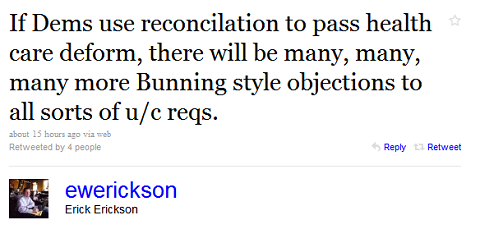
So reconciliation is on, and this has the usual suspects all in a huff:

These guys don’t even understand how threats work. Usually, to have some effect, you have to issue the threat PRIOR to engaging in the behavior. What could the Republicans possibly do that they haven’t already?

We’ve already seen record numbers of filibusters and clotures. They’ve already used every parliamentary trick in the books to bog down the legislation. They’ve negotiated in bad faith, stalled, and then voted en masse against. They’ve lied and misrepresented everything the Democrats have tried to do. They even insisted that we wheel the near dead Byrd onto the Senate floor late night, and openly prayed for the death of another Senator. And now we are supposed to fear obstructionism?

Bring it on. Up until now, the Democrats have suffered because people don’t really understand the concept of 60 votes, and have just wondered why Democrats don’t just pass their bills. They’ve looked at Democrats as the parents of an unruly child who just don’t have the nerve to get their kid in line.

But now, after the Bunning stunt, in which he wasted millions and deprived millions of needed aid, slowed down road construction, and made a bureaucratic nightmare of unemployment benefits, the American people got a glimpse of what is going on. One man had a hissy fit and thwarted the will of both parties.

So I say to Erick and the teabagging Republican Senators- bring it on. The neighborhood is starting to realize this is not just bad parenting, and now that the problem child isn’t just a problem for the parents, but is running around slashing everyone’s tires and generally making a mess of every damned thing, they are starting to pay attention. Even the media is running out of excuses and are starting to realize this isn’t 1994, but 1996.

So, go for it. I double dog dare you.
  • from the comments:

    Comrade Dread

    The only thing that mildly worries me is that the next time Republicans gain power, they’ll turn up everything to 11 and really go bats*** crazy.

    That being said, I kind of expect them to do that anyway, so what the h*ll?

Tim F.: Better Living Through Hippie Punching

Where is the mystery about Rahm stories? Mainstream media reporters hate hippie bloggers. Don’t know why. If I had to guess I would say that hippie bloggers make criticisms that cut deeper than the broad-brush personality-based drivel that right wingers typically serve up. A lot of managing editors (the guys who assign and approve stories, and who often lean Republican) want to be “more like FOX.” Bob Somerby has an Indiana Jones vault of evidence that most reporters arbitrarily split the difference between parties and cast around for excuses to punch hippies because it might blunt ‘liberal media’ criticisms (ha ha, I know, right). To some degree every case is a unique snowflake.

Newsroom staff don’t know much about policy and (like most people) almost nothing about Senate procedure but they can do personality and horserace in their sleep, and “access” is practically a currency in their world. No, scratch that last part. In DC ‘access’ is not practically a currency. It determines your status in the cocktail party hierarchy. It gives you job security. Getting a cold call from someone at Rahm’s level is like a researcher publishing in Science or Nature. After that you’re a made man. Compared with the agony of reporting health care minutiae compounded with Senate rules that even most Senators can’t reliably explain, this Rahm crap is a delicious chocolate sundae that makes you skinnier and whitens your teeth. It hardly seems like a disincentive that it also pisses off Media Matters and gives Somerby the fits.

John Cole: Truly Bizarre

Another day, two more Rahm stories.

I don’t think I have ever seen such an infatuation with a President’s Chief of Staff, ever. It really is insane.

Aravosis: 'At 50, Emanuel has the lean, taut look of a lifelong swimmer, with broad shoulders and distractingly prominent quadriceps.'
The new art form of pro-Rahm suck up pieces enter its homoerotic phase. I'm disgusted yet titillated at the same time. This must be how Sarah Palin supporters feel.
The leaked stories have gotten so bad that even Broder is calling foul. Will wonders never cease.
David Broder (WaPost): Emanuel and his 'advisers'

In the space of 10 days, thanks in no small part to my own newspaper, the president of the United States has been portrayed as a weakling and a chronic screw-up who is wrecking his administration despite everything that his chief of staff, Rahm Emanuel, can do to make things right.

This remarkable fiction began unfolding on Feb. 21 in the Sunday column of my friend Dana Milbank, who wrote that "Obama's first year fell apart in large part because he didn't follow his chief of staff's advice on crucial matters. Arguably, Emanuel is the only person keeping Obama from becoming Jimmy Carter," i.e., a one-term failure.

A week later, presumably the same anonymous sources convinced Milbank to pronounce that Obama "too often plays the 98-pound weakling; he gets sand kicked in his face and responds with moot-court zingers."

And on Tuesday, The Post led the paper with a purported news story by Jason Horowitz saying that a president with Obama's "detached, professorial manner" needed "a political enforcer" like Emanuel to have a chance of succeeding, "because he [Emanuel] possessed a unique understanding of the legislative mind." Unfortunately, the story said, "influential Democrats are -- in unusually frank terms -- blaming Obama and his closest campaign aides for not listening to Emanuel."

It sounded, for all the world, like the kind of orchestrated leaks that often precede a forced resignation in Washington.

Except that the chief of staff doesn't usually force the president out. When George H.W. Bush had had enough of John H. Sununu, of course it was Sununu who walked. Maybe the sources on these stories think Obama is the one who should leave.

Here in a few paragraphs is what others high in the White House think is going on:

The underlying problem, in their eyes, is a badly damaged economy that has sunk Obama's poll numbers and emboldened Republicans to blockade his legislative program.

Emanuel, who left a leadership post in the House to serve his fellow Chicagoan, Obama, has worked loyally for the president, and is not suspected personally by his colleagues of inspiring these Post pieces.

But, as one of them said to me, "Rahm likes to win," and when the losses began to pile up, he probably vented his frustrations to some of his old pals in Congress. It's clear that some of them are talking to the press.

There are good grounds for questioning the legislative strategy and tactics of this White House -- just as there have been with other administrations. A president who sets out to engineer large-scale changes in basic economic, social and legal structures at the same time he is fighting two wars and dealing with the fallout from a fiscal calamity is risking defeat. Obama has courted that risk knowingly because he thinks -- as I do -- the nation really is in peril. His party in Congress and its leadership are too often more narrow-minded and parochial than the president. And the Republicans have chosen the easy path of near-unanimous opposition.

None of this would rise above the level of petty Washington gossip, except that some of Emanuel's friends are so eager to exonerate him that they are threatening to undermine the president. Milbank, presumably reflecting what he hears, calls Obama "airy and idealistic" and says he readily succumbs to "bullying" from Republicans and Democrats alike. I hope the mullahs in Iran don't believe this.

From too many years of covering politics, I have come to believe as Axiom One that the absolute worst advice politicians ever receive comes from journalists who fancy themselves great campaign strategists.

Milbank now is urging Obama to emulate Gordon Brown, who is probably just weeks away from being voted out as Britain's prime minister, and start bullying people himself. That is -- well, it's in the great tradition.

Veins in his forehead.

Bodenner: Narrative Fail

While the Cheneys are busy making scary YouTube videos, Obama continues to execute the war on terrorism:

The Pakistani Taliban confirmed Tuesday that a senior commander wanted in the deadly 2006 bombing of the U.S. consulate in Karachi was killed in a suspected American missile strike in northwestern Pakistan.

DiA:

Guess someone at the CIA or Pentagon didn't get [Cheney's memo that the president is "trying to pretend we're not at war".] There has been a grievous failure to "connect the dots" here: despite overwhelming evidence from Fox News, Mr Cheney, Liz Cheney, Scott Brown and furious other torture supporters, the president, the military and the intelligence services seem not to have understood that they're supposed to think we're not at war. We risk a major attack on cherished narratives if this kind of complacency keeps up.

Elliott (TPM): Anatomy Of A Smear: Cheney Attacks DOJ Attorneys As Terrorist-Friendly (VIDEO)

An attack on Justice Department officials who previously represented detainees at Guantanamo was spawned by Sen. Chuck Grassley at a hearing last November, ricocheted around the right-wing media, and culminated today in a video release by Liz Cheney's group that all but accuses the lawyers of being terrorists.

The campaign-style ad from Cheney's Keep America Safe dubs the lawyers "the Al Qaeda Seven" and asks, "Whose values do they share?" while flashing a picture of Osama bin Laden. (Watch it below.)

At issue are DOJ lawyers who, before they joined the administration, represented detainees at Guantanamo, filed amicus briefs in detainee-related cases, or were involved in advocacy on behalf of detainees.

The names of two of the officials, Principal Deputy Solicitor General Neal Katyal and National Security Division Attorney Jennifer Daskal are known. But Republicans have seized on the fact that the DOJ isn't releasing the names of seven other officials who fit that description. Thus, the "the Al Qaeda Seven."

The critics are not only questioning the loyalty of top lawyers in the Obama Administration, but are also attacking the age-old and thoroughly American practice of lawyers defending clients with whose ideology they may not agree (see Adams, John).

Katyal represented Salim Hamdan, Osama bin Laden's driver, in the landmark case that led to the overturning the Bush Administration's military commissions. As senior counsel for Human Rights Watch, Daskal worked on detainee issues.

A professor at Georgetown, Katyal became one of the most celebrated young lawyers in the country after arguing -- and winning -- the Hamdan case before the Supreme Court.

The attack began at a Nov. 18 Judiciary Committee hearing. Grassley, Republican of Iowa, raised the issue with Attorney General Eric Holder, asserting that Katyal and Daskal have a conflict of interest. A couple weeks later, Grassley and the other committee Republicans asked the DOJ to produce a list of names of officials who previously worked with detainees. The department responded Feb. 18 with a letter from one of Holder's deputies that said nine officials fit Grassley's criteria. But the letter did not give the names.

The Republicans reiterated their demand for a list of names in a new letter on Feb. 26.

In the meantime, the interest in the story heated up in the right-wing media and spilled over into the mainstream. The Washington Examiner's Byron York seized on the DOJ's response to Grassley. National Review and the Weekly Standard got on the case. Michelle Malkin raged at "Corruptocrat AG Eric Holder." Investor's Business Daily published an editorial titled "Department of Jihad."

Finally, on Feb. 26, ABC picked up the story.

Today, the Web ad from Keep America Safe, which Liz Cheney founded as an outlet to advance her agenda last October, was featured on Politico. The Weekly Standard blogger Michael Goldfarb, who works at lobbying firm Orion Strategies and is also Keep America Safe's spokesman, told Politico: "Holder has hired lawyers who used to represent terrorists to work in President Obama's Justice Department, and he won't tell the American people who they are."

Despite the heated rhetoric (Grassley claimed that the DOJ officials' past work "creates a conflict of interest problem"), a legal ethics expert tells TPMmuckraker that there is no ethical breach.

"It is not a conflict of interest under the rules of any U.S. jurisdiction for a government lawyer who has represented detainees in private practice to work on detainee issues at the Justice Department.," Stephen Gillers, a professor at NYU Law school, said in an e-mail.

"Under U.S. legal ethics rules in every state, this is no different from hiring an antitrust lawyer, a criminal defense lawyer, or an environmental lawyer from private practice to work in the same general area of law for the government," Gillers said. "They, and a lawyer who has represented detainees, can work in the same field for government so long as they stay away from the specific matters on which they worked in private life."

The Justice Department said in its letter to Grassley that political appointees recuse themselves from particular cases in which they were previously involved.

Judiciary Committee Democrats have so far been silent on the issue. Press secretaries for several top Judiciary Dems did not immediately respond to requests for comment.

But some liberals who work on national security issues are outraged.

"It's not kind of like McCarthyism, it is exactly what Joe McCarthy did with his Communist witch hunts," Ken Gude of the Center for American Progress tells TPMmuckraker in an e-mail. "Cheney accuses the Attorney General of the United States of being a supporter of al Qaeda and running the 'Department of Jihad,'" a reference to the Investor's Business Daily editorial that is featured in the Cheney ad.

Watch the ad below:

Bodenner (Daily Dish): John Adams And The "Gitmo Nine"


A reader writes:

Whenever I read about Cheney and her ilk's galling demands that the government abdicate due process of law because they're more frightened of people in caves than our forebears were of the Soviet Union or Axis powers, I always think of John Adams and the Boston Massacre. I can only imagine what would be said today of someone who defended alleged terrorists if they were to run for high office. Adams' infamy over defending, and winning, a case for the hated British was eventually seen for what it was: a defense of liberty.

I couldn't find a clip of the courtroom scene from John Adams, the HBO miniseries, but the speech above hits all the right chords. And below is a diary entry of Adams recounting his feelings about defending the eight British soldiers - murder suspects that no other lawyer in Boston would represent. It's a must read for anyone interested in learning from a true Tea Party patriot:

Before or after the Tryal, Preston sent me ten Guineas and at the Tryal of the Soldiers afterwards Eight Guineas more, which were. . .all the pecuniary Reward I ever had for fourteen or fifteen days labour, in the most exhausting and fatiguing Causes I ever tried: for hazarding a Popularity very general and very hardly earned: and for incurring a Clamour and popular Suspicions and prejudices, which are not yet worn out and never will be forgotten as long as History of this Period is read...It was immediately bruited abroad that I had engaged for Preston and the Soldiers, and occasioned a great clamour....

The Part I took in Defence of Cptn. Preston and the Soldiers, procured me Anxiety, and Obloquy enough. It was, however, one of the most gallant, generous, manly and disinterested Actions of my whole Life, and one of the best Pieces of Service I ever rendered my Country. Judgment of Death against those Soldiers would have been as foul a Stain upon this Country as the Executions of the Quakers or Witches, anciently. As the Evidence was, the Verdict of the Jury was exactly right.

This however is no Reason why the Town should not call the Action of that Night a Massacre, nor is it any Argument in favour of the Governor or Minister, who caused them to be sent here. But it is the strongest Proofs of the Danger of Standing Armies.

Marshall: Spy Vs. Spy
You'll remember that Rep. Sue Myrick (R-NC) has pursued what can only be called a fairly anti-Muslim line during recent years in the United States Congress, culminating in her recent call to investigate Muslim "intern spies" operating on Capitol Hill. So you had to know it was going to be a raucous evening when she held a townhall meeting with the Muslim community in Charlotte last Thursday. Audio included.
Marshall: The Horror
First Shelby. Now Bunning. I don't know what the pithy way to phrase it is. But somehow the Democrats need to capture for people that the true horror of Republican rule would be every couple weeks having some cranky, seventy-something guy from the South pulling a freak out, screaming at the country to get off his lawn and shutting down the government until the veins in his forehead de-bulge.
Speaking of veins and foreheads . . .
C&L: Rush Limbaugh Compares Nancy Pelosi to a Terrorist

Ed Schultz calls out Rush Limbaugh, Michele Bachmann and Glenn Beck for their hate filled rhetoric in this edition of Psycho Talk.

My Hero Part 2

Visit msnbc.com for breaking news, world news, and news about the economy

My hero

Visit msnbc.com for breaking news, world news, and news about the economy

Tuesday, March 2, 2010

Sigh

Aravosis: Yesterday Susan Collins blamed Harry Reid for Bunning's filibuster, today she's helping Reid break it
Yesterday, Susan Collins was blaming Harry Reid for the Republican filibuster that took unemployment benefits away from millions of Americans. Today, Susan Collins is stumbling over herself to help Harry Reid break the filibuster. Guess the pressure was a bit too much for Collins. So is she now a socialist too?
Aravosis: Obama avoided taking jab at Bunning today, didn't want to seem partisan
A few minutes ago on CNN, Ed Henry reported that he'd been tipped off by the White House that Obama was going to take "a jab" at Senator Bunning today when he got off Air Force One today in Georgia. Bunning certainly deserves the jab.

Didn't happen.

According to Henry, the White House informed him that the Bunning line was removed from the President's speech because Obama felt it would be too partisan. And, in any case, the brain trust at the White House doesn't want to involve the President in every minute detail of what the Senate does.

Bunning's filibuster has blocked benefits for hundreds of thousands of unemployed Americans. It's stopped construction projects. It's not a minor thing. Time after time, Republican filibusters have put the brakes on Obama's agenda. And, why not? There are no consequences. The President sure doesn't hold them accountable. What Bunning is doing is probably one of the most egregious filibusters to date. But, he's getting a pass from Obama.

It might be a good idea for the President to engage himself in the Senate's proceedings when the consequences are so enormous. People might like to know that their President is fighting for them instead of avoiding a fight.
Marshall: Upending the Universe

Mike Kinsley once had a great line to the effect that what really irked Republicans about Bill Clinton's fundraising tactics was that he'd violated the cardinal rule of Washington which was that Democrats only get to use the latest and brassiest campaign tactics after the GOP has already been using them for several cycles.

And it seems like we've got something similar with reconciliation. What's outrageous is that Democrats have decided to avail themselves of the rules that Republicans have been using consistently for almost thirty years.

The only bizarre thing is how many reporters (though, candidly, fewer than I'd anticipated) really do think this is an immutable law of the universe.

Marshall: ClusterFail

Why am I not seeing prominent Democrats on TV, actually probably President Obama on TV, saying senate Republicans are wrong to be helping Sen. Bunning (R) create so much suffering for his own kicks and ideological predilections?

It's a mini-government shutdown but all I'm seeing on TV is "senate gridlock."

Marshall: The Filibuster That Dare Not Speak Its Name

It's become clear over the last 24 hours or so that Sen. Bunning (R-KY) isn't really alone in his filibuster that's triggering all these Medicare and Unemployment insurance cuts. He's being actively assisted or at least encouraged by a number of his Republican colleagues. But in a lot of press reports, not only are reporters unwilling to call it a filibuster, they don't even mention Bunning's name. It's just "senate gridlock."

Some of this has to do with the fact that even a few days in a lot Democrats seem bizarrely eager to keep this whole thing a secret. But it's really a press failure. Can you let me know when you see examples of the use of this phrase or other efforts to obscure what's going on here?

Booman: A Structural Advantage
I was watching MSNBC this morning and former Counselor to the President Dan Bartlett was on talking about the similarities between Bush's failed effort to privatize Social Security and Obama's current effort to pass health care reform. Bartlett said that in both instances the administrations made the mistake of focusing too much on the process of passing the legislation through Congress and not enough on winning the argument in the public square. I think I agree with that in a general sense. But it isn't exactly easy to win an argument of the merits of legislation when the other side is forcing you to constantly work on process. As Alexander Bolton ably explains in The Hill, the Republicans have been very successful in getting the American people to attribute shared blame for the gridlock in Washington.

Failure to advance must-pass legislation has added to the Democrats’ problems when Congress is suffering from its lowest approval ratings in years.

Democrats claim they can blame Republican obstruction for the gridlock, but political experts and some Democratic allies say the majority party will also suffer because it controls Congress.

This is even true in the current case of Sen. Jim Bunning denying unanimous consent to extend unemployment insurance (among other things):

Democrats decried Bunning and the GOP in a flood of press releases Monday, but those feeling the pain may not make distinctions.

“I certainly think the majority leadership understands what a catastrophe this is. They overestimated the good will of the Senate as a whole,” said Jody Conti, federal advocacy coordinator for the National Employment Law Project, a nonpartisan organization that advocates for low- and middle-income workers.

“The calls and e-mails we’re already getting are turning rapidly to, ‘Democrats have a supermajority, why can’t they move this through?’ Workers are placing the blame on both sides of the aisle,” said Conti.

Democratic strategists say their candidates will blast the GOP for obstruction. “If Republicans are stopping something as basic as helping the unemployed, they’re going to take a hit on it,” said John Anzalone, a Democratic pollster...

...But he said gridlock would also hurt the party in control. “People are seeing that their lives are being played with because of party politics, and that’s bad for everyone,” he said.

The more people hate Congress, the more that feeds into the Republicans' anti-government message. So, they have the luxury of using procedural moves to stall progress in Washington (even to the degree that it enrages a significant portion of the electorate) because the blame is spread out and hurts the party that wants to convince the people that the government can be a force for good.

There are obvious limits. The Republicans went too far in 1995 with the government shutdown and smoothed Clinton's path to reelecton. But they enjoy a basic structural advantage in that the Democrats can't really respond in kind when they are in the minority because they would catch nearly all the blame. In the case of Social Security privatization, it was a simple matter of the proposed legislation being incredibly unpopular. A less controversial bill proposed by a less unpopular president would not have been successfully stonewalled by the Democrats. It's just not in their nature.

Getting back to the point at the top, the Obama administration certainly failed to communicate their strategy for passing health care reform in a way that would have made their friends comfortable with the compromises they were making, and this led to the narrative about backroom deals and selling out to the insurance and pharmaceutical industries. But the kind of sordid deals that are required to pass reforms of this size are not the kind of things that look good in the light of day. It's hard to win over a Ben Nelson to vote for your reforms if you are simultaneously telling your supporters that you cut something out of the reforms because Nelson is a whore to the insurance industry and it was the only way you could get his vote. And I don't mean to single out Ben Nelson, because there were others who told the administration 'no' on a public option as far back as January.

It's hard to be candid about the difficulties of passing reforms when you are reliant on the people who are creating those difficulties to help you in the end. And that's what the GOP forced on the Obama administration with their unified opposition. Meanwhile, their use of procedural obstruction forced the administration to keep a constant eye on the congressional maze, which used up energy they needed to argue the case for reforms in the public square.

The Republicans really have been very effective. Even though they are incredibly unpopular, they've succeeded in making their opponents very unpopular, too. And the American people are wondering why the Democrats are having such a hard time passing their agenda, and giving them a healthy share of the blame.

  • from the comments:
    I think many underestimate the level at which the media play in all this. How can Democrats talk about substance when finding a news report in DC that covers policy over politics is like finding a drop of freshwater in the ocean.
    by The BBQ Chicken Madness

Kevin Drum: Jim Bunning and the End of Outrage

What is there to say about the Jim Bunning situation? It just leaves me speechless. We have here a situation in which the Senate is being hijacked, literally, by the ravings of a single cranky old man against a bill that the entire Republican leadership had already agreed to. It's pure pique, and the Republican Party is unwilling to do anything about it.

A lot of liberals have taken lately to calling the GOP nihilistic, and I've never bought it. Opportunistic? Sure. Brutally partisan? Sure. Vacuously unwilling to address the country's most serious problems? Sure. Ideologically frozen in the past? Sure. But nihilistic? On the contrary, they seemed driven by a brute cunning that I might even approve of if it were my own side doing it.

But then along comes Bunning, ranting against a temporary extenstion to unemployment benefits just for the sake of.....well, no one quite knows. For the sake of whatever demons are running around in his head, I guess. It's the kind of situation where a non-nihilistic party would finally step up and agree to rein the guy in. But that hasn't happened. The Republican leadership has, by all accounts, done nothing, and the rest of the caucus — or enough of it, anyway — has actually rallied around Bunning. Rallied around him! They know perfectly well he's a crackpot; they know perfectly well this is a bipartisan bill designed to provide working-class relief in the middle of a massive recession. But for guys like Bob Corker and Jeff Sessions and John Kyl it's more important to demonstrate solidarity with a crackpot than it is to help a few people out. "I admire the courage of the junior senator from Kentucky," said John Cornyn, apparently speaking for many.

Nihilism is probably still the wrong word for this. But I guess it's close enough for government work. Whatever it is, it's a very deep rot in the soul of the Republican Party.

And why won't they pay a price for this? Well, partly because Democrats aren't willing to force them to. But it's also partly because of how this gets played to most of the public. One of the consequences of Bunning's objections is that Medicare payments for doctors went down 21% effective yesterday. And whose fault is this? According to the AMA, it's the fault of the "U.S. Senate." Here's their press release:

“The Senate had over a year to repeal the flawed formula that causes the annual payment cut and instead they abandoned America’s seniors, making them collateral damage to their procedural games,” said AMA President J. James Rohack, M.D. “Physicians are outraged because the cut, combined with the continued instability in the system, will force them to make difficult practice changes including limiting the number of Medicare patients they can treat.”

Not "Jim Bunning." Not "the Republican Party." It's the fault of "the Senate." This sort of thing gets played out in headlines around the country, and the result is disgust with government and disgust with Congress. But it doesn't affect Republicans any more than Democrats until the headlines change.

digby: Creating Chaos
FYI: the village, in the person of Mrs Alan Greenspan, just responded to the absurd assertion of GOP mouthpiece John Feehery that the Democrats are to blame for Jim Bunning's obstruction because the Senate should have passed this extension of unemployment benefits bill months ago by saying:
You can certainly make the argument that the whole process has broken down and that no one is running the Senate.
Right. A Republican using an obscure parliamentary procedure to hold up unemployment benefits for hundreds of thousands of Americans in a time of double digit unemployment but the villagers agree that it is really the fault of Democrats because they are in charge and should be able to "ram it through" (except when "ramming it through" would be undemocratic and destructive to the comity of the Senate and the fabric of our nation.)

Let's be clear. Bunning couldn't have done this without the help of his Republican pals who have an interest in creating misery, which is their ticket back to the majority. And they are aided and abetted by a political establishment that is simultaneously demanding that Democrats capitulate and dominate, both of which are then subject to criticism and characterization as massive failures. They are creating chaos then blaming the Democrats for allowing it to happen.

The narrative is gelling --- the Democrats are both hapless and ruthless and must be replaced by principled, conservative "grown-ups." We've been here before.

And consider what's driving these principled, conservative "grown-ups" this time:

Benen: MEET BARBARA MILANO KEENAN
Nearly seven months ago, President Obama nominated Judge Barbara Milano Keenan to serve on the 4th Circuit Court of Appeals. Her record and qualifications were beyond reproach, and she enjoyed the enthusiastic support of her home-state's senators, Virginia's Jim Webb (D) and Mark Warner (D).

Her nomination was considered nearly six months ago by the Senate Judiciary Committee, which approved Keenan unanimously -- not single Republican raised an objection. If ever there was going to be an Obama judicial nominee who deserved to be quickly and easily confirmed, Keenan fit the bill.

And yet, the Senate Republican caucus is the Senate Republican caucus. Keenan's nomination was delayed, then, because of a GOP filibuster. Why? No one has the foggiest idea. It's apparently just habitual -- Republicans try to block judicial nominees just for the same of trying to block judicial nominees.

This morning, the Senate held a cloture vote to end the Republican filibuster on Keenan. The vote was 99 to 0. This afternoon, the Senate held a final confirmation vote, and produced the same margin. (thanks to reader G.S.)

The Senate has unanimously confirmed Virginia Supreme Court Justice Barbara Milano Keenan to a seat on the U.S. Court of Appeals for the Fourth Circuit.

The vote Tuesday was 99-0 for Keenan, the first female judge elected in Virginia and the only woman appointed to the Virginia Court of Appeals when it was created in 1985. The Richmond-based Fourth Circuit covers Virginia, Maryland, West Virginia, North Carolina and South Carolina. [...]

Sen. Jim Webb, D-Va., lamented that there are now some 100 vacancies among 876 federal judgeships, that the Fourth Circuit currently has four vacancies and that the seat Keenan will fill has been empty for two years.

Keenan's nomination was delayed for months by a filibuster, only to see her win unanimous confirmation. In other words, those who sought to block her nomination ultimately voted against their own obstructionism, and for the judge they tried to stop.

It's one thing to block an up-or-down vote on a judge some senators find problematic. But we have a Senate where Republicans filibuster nominees who enjoy unanimous support. We're left with a confirmation process in which it takes seven months to approve arguably the least controversial judicial nominee this administration will ever send to the Senate.

Also note, it's not just Keenan -- there are several pending judicial nominees, all of whom have been approved by the Judiciary Committee, some with unanimous support, who continue to wait for no good reason.

This is an untenable process.

Marshall: Bunning Forced to Bat?

There's a report that Democrats are going to force Sen. Bunning (R-KY) to mount an actual filibuster tonight. Senate Dems seem to be officially denying it for now.

That raises the question of, if they're forcing a real filibuster in this case, why not during health care.

The answer is actually pretty straightforward. If it's just Bunning, the Dems can keep calling for unanimous consent and Bunning has to stay there on the floor to block it. As soon as he needs to sleep or just go to the bathroom they can rush to the floor, call for unanimous consent and then that's it.

Add a few more people, though, or add two or three dozen then it gets very easy to fight off. You just have one guy take an hour shift, followed by another person, followed by another. And maybe you have two on the floor at all times to prevent any mistakes.

If you've got 40 people, it's not hard to do it in shifts and even have it be relatively painless.

And remember, you don't have to keep talking. All you have to do is sit their and be ready to object.

Benen: BUNNING GETS BY WITH A LITTLE HELP FROM HIS FRIENDS

Sen. Jim Bunning's (R-Ky.) temper tantrum has caused quite a mess from coast to coast. Tens of thousands of unemployed workers are getting screwed, as are thousands of furloughed highway workers, small businesses, and medical professionals. Bunning's rationale isn't even coherent, but his callous crusade continues.

It's been interesting, though, to see Bunning's Republican colleagues respond to the tantrum. The underlying measure was poised to be approved unanimously -- that is, without GOP objection -- but notice that Senate Republicans haven't made any real efforts to cut Bunning's lunacy short. Granted, the GOP leadership may have limited influence over the Kentucky senator -- the borderline-unstable member is retiring later this year -- but that doesn't explain the support Republicans are offering.

Corker Defended Bunning, Said Senate Was "Stooping To A Low Level." On the Senate floor, Senator Corker defended Senator Bunning and said, "I believe we are stooping to a low level. The Senator from Kentucky and I agree on a lot and we disagree on a lot, and I am not here at this moment to debate the merits of either side. What I am saying is this is not the way the Senate functions. Everybody in the country now knows that the Senator from Kentucky has a hold on this bill. That is something that is honored. Not a hold on the bill, but he is objecting to unanimous consent, and that is something that we honor in this body." [Congressional Record, 2/25/10]

Sessions Defended Bunning, Said He's Blocking Unemployment Benefits "As A Matter Of Principle." On the Senate floor, Senator Sessions defending Senator Bunning and said, "I think the Senator from Kentucky is speaking on behalf of the conscience of a lot of Americans, a majority of Americans, if they heard this debate. He is doing it as a matter of principle. I know he has no desire to see people not receive unemployment compensation. He is willing to support that. He simply is saying that enough is enough." [Congressional Record, 2/25/10]

Sessions Again Defended Bunning, Said He Respects Bunning's "Courage." Just yesterday, Senator Sessions again defended Senator Bunning. Sessions spoke about Bunning's actions on the Senate floor and said, "I respect him for the courage he showed. [Congressional Record, 3/1/10]

Cornyn Admires Bunning's "Courage." Senator Cornyn took to the Senate floor, suggested that Senators Bunning and Corker were not afforded the procedural opportunity to explain the GOP filibuster of unemployment benefits and said, "I understand that Senator Durbin retained the floor for the most part and yielded for questions, but basically the procedure denied Senator Bunning and Senator Corker, who I know also weighed in, an opportunity to explain precisely what was going on…. I want to say I admire the courage of the junior Senator from Kentucky, Mr. Bunning." [Congressional Record, 2/26/10]

Kyl Defended Bunning, Said He "Made A Good Point." "Bunning got support from Senate Republican Whip Jon Kyl, who defended his colleagues insistence of paying for the legislation with unused stimulus funds. 'You can't say that everything we do around here needs to be offset,' said Kyl, 'and then waive the pay go legislation every time you want to do it.' 'My colleague from Kentucky made a good point.'" [Politico, 3/1/10]

"Bunning's blockade" is wreaking havoc, and leading Republicans aren't denouncing him -- they're encouraging him.

This is the modern Republican Party? In an election year?

For his part, Senate Minority Leader Mitch McConnell (R), Bunning's fellow Kentuckian, was asked repeatedly this morning whether Bunning's tantrum was defensible. McConnell refused to answer.

No "Profile in Courage" award for you, Mitch.


Reconciliation Standup Comedy

QOTD, Chait:

Look, it would be okay for reporters and pundits to be obsessed with what legislative method is employed to pass health care reform if they boned up on the issue. Alternatively, it would be okay for them not to understand it at all if they deemed it an irrelevant issue. (Which, in my opinion, it is.) But obsessed and ignorant makes for a bad combination.

I've been getting some e-mail lately about Warren Buffett apparently attacking health-care reform. Turns out he didn't, but that Fox News is saying he did. The relevant quote comes from an interview Buffett gave to CNBC on Monday. "If it was a choice today between plan A, which is what we've got, or plan B, the Senate bill, I would vote for the Senate bill. But I would much rather see a plan C that really attacks costs."

So would I, and so would the Obama administration. No one is saying the Senate bill is perfect. But they're saying it's far preferable to the status quo. Fox News, meanwhile, is saying that Buffett said "he simply cannot go along with this particular health care bill." In fact, he said the exact opposite. I continue to be amazed that lying brazenly to your audience is such a good business strategy.

Orrin Hatch (R-UT) argues against an up-or-down vote on health care reform and invents his own Constitution to make his case:

This is attractive to proponents because it sharply limits debate and amendments to a mere 20 hours and would allow passage with only 51 votes (as opposed to the 60 needed to overcome a procedural hurdle). But the Constitution intends the opposite process, especially for a bill that would affect one-sixth of the American economy.

And not only would an up-or-down vote fly in the face of the Hatch Constitution, it could:

... damage the prospects of bipartisanship.

Comedy.

Benen: MEDIA SCREWS UP CONRAD STORY

Sen. Kent Conrad (D-N.D.), chairman of the Senate Budget Committee, appeared on CBS's "Face the Nation" yesterday, and made some comments news outlets took very seriously. The lead story on Mark Halperin's "The Page" yesterday, for example, told readers, "Conrad: Reconciliation Can't Do Comprehensive; Budget gatekeeper says Sunday full health care package by 51 just 'won't work.'"

This Politico report was even more dramatic.

Sen. Kent Conrad (D-N.D.) threw cold water on the idea of using the reconciliation process Sunday during an appearance on CBS' "Face the Nation."

"Reconciliation cannot be used to pass comprehensive health care reform," said Conrad, chairman of the Senate Budget Committee. "The major package would not be done through reconciliation."

Asked by CBS host Bob Schieffer to elaborate, given that the White House suggested earlier Sunday that they could pass the main bill with a simple majority of 51 votes, Conrad said that reconciliation was not, in fact, an option.

Reporters found Conrad's comments provocative and newsworthy for only one reason: the media is taking Republican talking points seriously, and doesn't realize the GOP rhetoric is nonsense.

If Dems were trying to pass a comprehensive health care reform package through the Senate using reconciliation rules -- the way Republicans keep insisting -- Conrad's on-air remarks might be important. But that's not reality. Democrats already passed a comprehensive health care reform package through the Senate using the regular ol' legislative process. The talk, at this point, is about using reconciliation for a budget fix, which incidentally, is why reconciliation exists. It's really not that complicated.

The news outlets that jumped on Conrad's observation didn't realize just how ordinary his remarks really were.

Jon Chait posted the transcript, which makes it clear Conrad is actually on board with exactly what Democrats intend to do: House passes Senate bill, Senate approves modest, budget-related amendments through reconciliation. This wasn't the senator throwing "cold water" on the Dems' plan; this was Conrad endorsing the Dems' plan.

Chait concluded, "Look, it would be okay for reporters and pundits to be obsessed with what legislative method is employed to pass health care reform if they boned up on the issue. Alternatively, it would be okay for them not to understand it at all if they deemed it an irrelevant issue. (Which, in my opinion, it is.) But obsessed and ignorant makes for a bad combination."

Sargent: Kent Conrad Rips Media: Yes, We Can Do Reform Via Reconciliation

In an interview with me just now, Senator Kent Conrad tore into the media for repeatedly botching its reporting on reconciliation, and confirmed that in his view, the current plan being entertained by Obama and Dems to pass reform via that tactic can, in fact, be made to work.

Conrad, the budget committee chair, also offered his most detailed explanation yet for why the House must pass the Senate bill first, before the Senate passes its reconciliation fix.

Conrad caused a big stir yesterday by saying: “Reconciliation cannot be used to pass comprehensive health care reform.” This was widely interpreted as claiming that the Dem way forward is a non-starter.

But Conrad patiently explained that the media interpretation of his comments is wrong. He was merely saying reconciliation would not be used to pass a comprehensive bill, and would only be used to pass the sidecar fix, which he said is workable, depending on what’s in it.

“Reporters don’t seem to be able to get this straight,” Conrad said, hitting the “misreporting” he said is widespread. “Comprehensive health care reform will not work through reconciliation. But if the House passes the Senate bill, and wants certain things improved on, like affordability, the Medicaid provisions, how much of Medicaid expenses are paid for by the Federal government, that is something that could be done through reconciliation.”

“A sidecar would be a good candidate for reconciliation depending on what’s in it,” Conrad said, adding that he didn’t think fixes to abortion or immigration provions would likely work, something that could create obstacles to passing the Senate bill in the House.

Conrad also explained in new detail why he believes that the House must pass the Senate bill first, a view that has been denounced by some critics who want the Senate to pass its fix before the House acts.

Conrad said that under Congressional rules, for a reconciliation fix to be “scored,” it’s not necessary that it become law, but it is necessary for it to have passed both houses of Congress before getting fixed. “For the scoring to change it has to have passed Congress, and that means both houses,” he said.

“The only thing that works here is the House has to pass the Senate bill,” Conrad continued. “Then the House can initiate a reconciliation measure that would deal with a limited number of issues that score for budget purposes.” After that, the Senate would pass the same reconciliation fix, Conrad explained, because even on the fix itself the House must go first because the lower chamber must initiate “revenue bills.”

Got that? It does look like this is how it’s all going to go down.

*********************************

Update: John Boehner spokesman Michael Steel emails a response:

“The American people have already rejected Washington Democrats’ trillion-dollar government takeover of health care stuffed with tax hikes, Medicare cuts, and special-interest giveaways. They have been crystal clear and loud as a buzzsaw on this issue. Trying to jam their latest job-killing backroom deal through Congress using this procedural trick would be a serious mistake.”

Republicans go 'nuclear' with health reform distortions
March 1: DNC chair Tim Kaine talks with Rachel Maddow about the lengths to which Republicans will go in their opposition to reforming health care in America, including a disinformation campaign on the American public to conflate the reconciliation process with "the nuclear option."

Visit msnbc.com for breaking news, world news, and news about the economy

Think Progress: Lamar Alexander Won’t Rule Out Using Reconciliation To Repeal Health Care Reform

Yesterday on ABC’s This Week, Sen. Lamar Alexander (R-TN) attacked Democrats for considering using reconciliation to pass health care reform, saying it would be “the end of the Senate.” Yet Alexander himself has voted for bills using reconciliation at least four times in his Senate career.

Today on Fox News, Alexander said that if Democrats pass health care, he will lead the GOP charge to repeal it. “We’ll spend the rest of the year in the campaign to try to repeal it,” he said, adding that “the health care bill is going to define every Democratic candidate for every public office in November.”

Later on ABC’s Top Line, Alexander again attacked reconciliation and reiterated his repeal pledge, but the Tennessee senator wouldn’t rule out using reconciliation to repeal health care reform:

Q: If the Democrats succeed in jamming this through on reconciliation, would you be open to using the very same process – reconciliation – to repeal health care reform?

ALEXANDER: I don’t like using the reconciliation for this. I’ve tried to be consistent in my views. […]

Q: Is reconciliation something you would say, “We would never use for something substantive legislation like health care?” Are you prepared to make that kind of statement?

ALEXANDER: No I’m not going to prepare to make any kind of statement. I’m prepared to say it shouldn’t be done now and if it shouldn’t be done now it shouldn’t be done in the future.

Watch it (starting at 4:40):

It doesn’t make sense that using reconciliation to pass health care reform would be “the end of the Senate,” yet using the process to repeal it would be perfectly acceptable.

“The goal of the repeal movement is to intimidate Democrats into inaction and raise money,” notes the Wonk Room’s Igor Volsky, adding that “they’ll be attacked for voting for an unpopular bill and portrayed as weak for abandoning an effort they fervently championed. Then again, if Democrats are willing to take their campaign advice from Republicans, maybe they shouldn’t be in Congress in the first place.”

Khimm (MoJo): McCain's Reconciliation Flip-Flop

This Sunday on "Meet the Press," Sen. John McCain announced that he plans to introduce an amendment that would prohibit the Democrats from using reconciliation to make changes to Medicare. Entitlement programs "should not be part of a reconciliation process," he declared to David Gregory, referring to the filibuster-proof procedure that requires only 51 votes. "It’s too important."

But just five years ago McCain himself voted to use reconciliation to make spending cuts to an entitlement program—in this case, Medicaid. McCain, along with 30 other current Republican senators, used a simple majority to pass George W. Bush's 2005 Deficit Reduction Act, which, among other things, "reduced Medicaid spending and allowed parents of disabled children to buy into Medicaid," as Greg Sargent notes. (Sargent's list of all the Republicans who have voted for reconciliation over the past 20 years is worth a look.)

McCain's hypocrisy blows a hole in the Republicans' contention that if Democrats use reconciliation to pass health care reform, they'll "end the Senate" as we know it. While the GOP has accused Democrats of "ramming" and "jamming" reform through the Senate, the bill in question already passed the Senate back in December. If that measure manages to clear the House, the Senate will only be passing limited tweaks to its bill via a so-called reconciliation sidecar—not pushing through a massive overhaul of the entire legislation. And although some of those fixes may apply to Medicare and Medicaid, they fall squarely within accepted reconciliation procedure, which is used for legislative tweaks that directly affect the federal budget.

Of course, Republicans themselves have long pushed for much deeper spending cuts to entitlement programs, only to turn around and accuse the Democrats of slashing benefits for vulnerable Americans. All of which makes it clear that McCain's latest flip-flop is just a political maneuver intended to derail reform, not some principled defense of the democratic process.

Benen: HATCH ABANDONS PRETENSE OF INTELLECTUAL SERIOUSNESS
I realize Sen. Orrin Hatch (R-Utah) is a sitting U.S. senator, but I'm hard pressed to imagine why the Washington Post agreed to publish such intellectually dishonest nonsense.

To impose the will of some Democrats and to circumvent bipartisan opposition, President Obama seems to be encouraging Congress to use the "reconciliation" process, an arcane budget procedure, to ram through the Senate a multitrillion-dollar health-care bill that raises taxes, increases costs and cuts Medicare to fund a new entitlement we can't afford.... [T]he Constitution intends the opposite process, especially for a bill that would affect one-sixth of the American economy.

Mustang Bobby noted in response, "Orrin Hatch thinks you're stupid," which seems to summarize things nicely.

Hatch has been around long enough (he joined the Senate 33 years ago) to know that his claims aren't true. He says reconciliation is "arcane," but it's not. Hatch argues President Obama wants to use majority-rule to pass the health care reform package, but he doesn't. Hatch says the Constitution discourages the Senate from approving legislation by majority rule, but it doesn't.

We're not talking about gray areas, or debates that are open to interpretation -- Hatch is simply and unambiguously wrong. And the Post published his demonstrably false arguments anyway.

This was especially rich:

[W]hen President George W. Bush and Congress created the prescription drug benefit in 2003, we Republicans in the Senate decided against using reconciliation because it would have made the plan partisan and condemned this important legislation to failure. Instead, the bill garnered significant bipartisan support -- demonstrating why reconciliation was not even attempted. That precedent should carry the day here.

What Hatch conveniently forgets is that reconciliation wasn't used when Republicans expanded Medicare (without paying for it) because Democrats didn't filibuster the final bill. The GOP didn't skip majority rule because of the goodness of their hearts; the Republican majority skipped it because they didn't need it. "That precedent should carry the day here"? Why, that's a great idea. As soon as partisan hacks like Hatch let the Senate vote up or down on major pieces of legislation, the way Senate Democrats did in 2003 and the way the chamber operated for the better part of 200 years, that precedent will be honored.

The whole pitch is absurd to the point of being insulting. Hatch has repeatedly supported up-or-down votes on legislation large and small. Indeed, he thought it was a great idea for delivering massive tax breaks for the rich -- packages that cost far more than health care reform now -- but whines incessantly when Dems consider the same procedure to pass a modest fix related to health care.

Hatch really ought to be embarrassed. His op-ed strays so far from reality, it reflects the perspective of someone who is either brazenly dishonest or shockingly confused about the basics of current events. Either way, this is a sad joke.

Update: I should also note that Hatch treats Senate procedures in his op-ed as somehow sacrosanct. But it doesn't take long to look into Hatch's background and realize he abandons institutional procedures and traditions whenever it suits his purposes. It's what dishonest hacks always do.

Second Update: Sargent takes a closer look at Hatch's history with reconciliation: In composing this treatise, Hatch naturally faced a problem: "How to address the numerous times he voted for reconciliation measures himself? His solution: He simply omitted all mention of his numerous votes for reconciliation measures that passed by a simple majority."

  • from the comments:

    This is tribal politics pure and simple. What is really shocking is to watch how much the various news outlets have also been coopted by tribal politics. I really had hoped that they had Fox News and we had everyone else. With the exception of the NYT and McClatchy, all of the major news outlets -- AP, CNN, ABC, NBC, CBS, the Washington Post, even NPR etc, -- have been coopted by or capitulated to the Republican Party. I don't find the corporatist rhetoric from secular animist, ron beyers, or neill necessarily convincing, but I am left scratching my head at why the coverage is so lop-sided. They are delivering a strong headwind to the Republican resurgence, and it has nothing to do with wanting a horse race. Once in office, they always give the Republicans a free pass to do whatever they want. Again, we might not be a center-right Country, but our news media sure is. The question is why? And yes, I am sure it is complicated.

    Posted by: Scott F. on March 2, 2010 at 11:18 AM
Atrios: Wankery
Greg directs his ire at Orrin Hatch, but the real problem is Fred Hiatt, whose vision of the modern newspaper editorial page, and the modern editorial page editor, involves letting the "right" people say anything they want even if it contradicts the paper's own reporting.

I think we're long past the time when most print newspapers could've been saved by simply providing a better product, but I also think there was a window to save, if not the print versions, the institutions which published them. Obviously the WaPo can survive as long as Kaplan Test Prep makes enough to keep them afloat, but I do wish more journalists bemoaning the losses in their industry would recognize that at least to some degree ceasing to be relevant and authoritative publications is a part of the problem. Why should people read them when they have to spend a lot of time figuring out when they're being bullshitted?

Monday, March 1, 2010

What E.J. said ....

E.J. Dionne (WaPost): Living with partisanship

The word "partisanship" is typically accompanied by the word "mindless." That's not simply insulting to partisans; it's also untrue.

If we learn nothing else in 2010, can we please finally acknowledge that our partisan divisions are about authentic principles that lead to very different approaches to governing?

Last week's health-care summit was a day-long seminar that should make it impossible for anyone to pretend otherwise -- and Republicans on the Sunday talk shows said yet again that they had no intention of making it any easier for President Obama to pass his health-reform plan. But before we get to that, let's examine the Senate debate over whether to extend unemployment insurance coverage. The matter is rather urgent for jobless workers because 1.1 million of them are scheduled to lose their benefits this month, and 2.7 million are slated to lose them by April.

Sen. Jim Bunning (R-Ky.) has put a hold on the extension bill, but one of the key reasons the measure is blocked is the effort of Sen. Jon Kyl (R-Ariz.) to use it as a way of forcing a cut in the estate tax. Kyl is essentially leveraging the unemployed to get a deal on estate tax relief that would cost $138 billion over the next decade, according to estimates by the Center on Budget and Policy Priorities. The estate tax has already been cut sharply, so the reduction Kyl is pushing along with Sen. Blanche Lincoln (D-Ark.) would affect the estates of fewer than three out of every 1,000 deceased, according to the Tax Policy Center.

The proposal helps estates worth more than $7 million in the case of couples. I guess struggling millionaires deserve the same empathy we feel for those without a job.

And notice this: Especially in the Senate, what passes for "bipartisanship" too often involves a Democrat such as Lincoln allying with a Republican on behalf of the wealthiest interests in the country. And we're supposed to cheer this?

At the health summit, the most revealing exchange was between the president and Sen. John Barrasso, a Wyoming Republican who is also a physician. Barrasso's central concern is that the health-care system doesn't operate enough like every other market. He seemed troubled less by the many Americans who lack health insurance than by those who abuse the insurance they already have.

Addressing Obama, Barrasso suggested that we might be better off if people were insured only for catastrophic care. "Mr. President, when you say [people] with catastrophic plans, they don't go for care until later, I say sometimes the people with catastrophic plans are the people that are [the] best consumers of health care in . . . the way they use their health-care dollars."

"A lot of people" with insurance, he added, "come in and say, 'My knee hurts, maybe I should get an MRI,' they say. And then they say, 'Will my insurance cover it?' That's the first question. And if I say 'yes,' then they say, 'okay, let's do it.' If I say 'no,' then they say, 'Well, what will it . . . cost?' And 'What's it [going to] cost?' ought to be the first question. And that's why sometimes people with . . . catastrophic health plans ask the best questions, shop around, are the best consumers of health care."

Obama played the old TV character Columbo, who thrived on posing seemingly naive questions: "I just am curious. Would you be satisfied if every member of Congress just had catastrophic care? Do you think we'd be better health-care purchasers?"

Barrasso answered in the affirmative, though he didn't propose that senators dump their present coverage. Obama came right back: "Would you feel the same way if you were making $40,000 . . . because that's the reality for a lot of folks. . . . They don't fly into [the] Mayo [Clinic] and suddenly decide they're going to spend a couple million dollars on the absolute, best health care. They're folks who are left out."

Obama concluded: "We can debate whether or not we can afford to help them, but we shouldn't pretend somehow that they don't need help."

As neatly as anything I have seen, this exchange captured the philosophical and emotional difference between the two parties. Democrats on the whole believe in using government to correct the inequities and inefficiencies the market creates, while Republicans on the whole think market outcomes are almost always better than anything government can produce.

That's not cheap partisanship. It's a fundamental divide. The paradox is that our understanding of politics would be more realistic if we were less cynical and came to see the battle for what it really is.