Tuesday, June 23, 2009

Health Care: Can They Be Taught? Edition

Krugman: The medical-industrial complex and the public option Fascinating statistical work by Nate Silver. It doesn’t support the crude view that it’s all about special interest money, but suggests that the money is making the odds substantially longer.

Krugman: Competition, redefined

Great catch by Digby, who quotes Sen. Blanche Lincoln about how terrible it would be if a government-run insurance plan undermined free-market competition, then links to this:

The Justice Department considers an industry to be “highly concentrated” if one company has 42 percent of the market. In Arkansas — Senator Lincoln should take note — Blue Cross Blue Shield has 75 percent of the market. If you take government self-insurance plans out of the equation, it’s higher. The state ranks as the ninth most concentrated in the country. Is it any wonder that insurance premiums have risen five times as fast as wages?

The truth is that the notion of beneficial competition in the insurance industry is all wrong in the first place: insurers mainly compete by engaging in “risk selection” — that is, the most successful companies are those that do the best job of denying coverage to those who need it most. But in any case, Arkansas is in effect a one-insurer monopoly state, with no competition at all — unless a public plan is created.

In fact, I may have a new hypothesis about the political economy of the health care fight. One thing that’s obvious, if you look at the balking Democrats I chided in today’s column, is that almost all of them come from states with small population. These are also, by and large, states in which one or at most two private insurers dominate the market.

So here’s a suggestion: while the opponents of a private plan say that they’re trying to defend market competition, what they’re actually doing is defending lucrative local monopolies.
The problem with health care June 22: Former Gov. Howard Dean discusses why it's been difficult for members of Congress to devise a health care reform plan that can win enough votes to pass and still be worthwhile.


Krugman: Two reactions to Ezra Klein

Ezra takes Meet The Press to task, rightly, for totally misinforming viewers about the health care debate:

Less forgivable was Nina Easton’s performance on the actual program last weekend. She explained to the viewers that “the big speed bump this week, of course, was that CBO, Congressional Budget Office, study that said that the costs of a public plan are going to be well beyond what they expected.” Later, she said that the CBO estimate “showed that 16 to 23 million people would lose their private or other type of health insurance if that public plan went through.” One problem: The bill that the CBO scored didn’t have any public plan in it at all. Her statements were simply untrue.

I’d just add that this kind of laxness amounts to malfeasance. Here we have the most important domestic policy issue on the table — one that will deeply affect the lives of of Americans, probably for generations to come. And they can’t get even the most basic facts straight?

Elsewhere, Ezra asks,

Are Republicans in this to preserve the healthy functioning of a competitive private market or preserve the profits of the currently dominant insurance companies?

That’s a rhetorical question, right? Bear in mind that in most small states there’s hardly any competition among insurers. It’s not “the market” that’s being protected; it’s the 21st-century equivalent of the old New York steamboat monopoly.
SGW: Democrats Are The New Repubicans
I want to fully associate myself with everything that is said on this clip from Bill Maher and also Cenk Uygur. At some points we are going to need for Democrats to get back to being Democrats and for the media to start being honest with their coverage of the health care debate!


dday: Learn, Damn You, Learn!!!
Something fairly interesting happened today. It doesn't mean we will get a public health insurance option to compete with the insurance industry, but it doesn't exactly hurt. Apparently some Democrats thought that if they only watered down such a public option to nothing, they would get that vaunted bipartisan support, and everybody could go back to their districts and claim they did something when they in fact would have done nothing. But as those of us who have been observing this have known for some time, these aren't your father's Republicans, or your grandfather's, or any other relative. They are the rump conservative party, openly hostile to using government for any means other than profit-taking, and preferring to tell their constituents "good luck" instead of making any tangible difference to their struggles. And somehow, Democrats just discovered this.
Some Senate Democrats have considered nixing the public option proposal in order to win Republican support for the bill.

Schumer's role is important because he had been acting as an intermediary between liberal Democrats and moderates who are trying to strike a deal on the issue with Republicans on the Senate Finance Committee. Of the five House and Senate committees working on health care, Finance is the only one that appears to have a chance at reaching a bipartisan agreement.

Schumer said Finance Republicans had rejected several proposals designed to beef up the suggested nonprofit insurance co-ops. These included setting up a national structure for the co-ops, $10 billion in government seed money, power to negotiate payment rates to medical providers nationwide and creation of a presidentially appointed board of directors.
The Democrats tried to basically bury the public option as long as they could get any manner of support for the weak substitute. And the Republicans wouldn't budge. Like in 1993, their mission is to kill health care reform, period. Why anyone would think that any alternative would be true is beyond me, but Senate Democrats obviously needed to play Tic-Tac-Toe with the computer endlessly until they realized what a strange game it all is, and that "the only winning move is not to play." Ezra Klein comes to the same conclusion.

Republicans, (Schumer) suggests, are standing lockstep even against efforts to create a private co-op system that could offer an alternative to for-profit insurance. Their concern with the co-op plan is not that the government would be taking over the health-care system. It's that the current insurance providers would face unexpectedly aggressive competition in the marketplace. Which raises an interesting, and potentially clarifying, question: Are Republicans in this to preserve the healthy functioning of a competitive private market or preserve the profits of the currently dominant insurance companies?
Further proof of that learning experience came today from Kent Conrad, the man who devised this health co-op plan by throwing a dart against a board, as he appeared to acknowledge its limitations.

The wheels looked to be coming off with health care reform last week. But a poll showing huge public support for a public health care option and a strong bill from the House of Representatives have changed the dynamic.

Schumer and other backers of a public option insist that any plan must be national in scope, have substantial funding at the beginning from the federal government, and include national purchasing power in order to negotiate lower prices.

Conrad ticked off the areas of agreement that were reached Monday.

"National structure: I believe to be effective there has to a national entity with state affiliates and those affiliates have to have the ability to regionalize. I think his concern there can be addressed," said Conrad. "Second, he believes there needs to be national purchasing power. I think that's a good point that the national entity would be able to do purchasing on behalf of the state and regional affiliates and on behalf of the national entity itself."
Now, Schumer's vision of a public plan is a compromise from the House vision of a public plan, which is a compromise from single-payer health insurance. But things are moving in a better direction today than yesterday, when DiFi flat-out said Democrats don't have the votes to pass anything.

This teachable moment has a value for those outside the system who want to push for a real public option that can use bargaining power to force competition from insurers. Because now, as Matt Yglesias says, there's no excuse for Democrats to water down their bills in order to "seek bipartisanship" and make them durable. Republicans have revealed themselves. And given budget reconciliation and the imminent fact of 60 votes in the US Senate, Democrats have nobody else to blame. They can talk about political realities but those have essentially been voted out of existence, with respect to Republicans. Whether it's because of health industry campaign contributions or a desire to limit competition in small, rural states, a desire to get the glory for saving policy from the brink or just an ideological disinclination, individual Senate Democrats will have the collapse of any health care reform on their hands.
And yes, I mean Democratic senators. The Republicans, with a few possible exceptions, have decided to do all they can to make the Obama administration a failure. Their role in the health care debate is purely that of spoilers who keep shouting the old slogans — Government-run health care! Socialism! Europe! — hoping that someone still cares [...]

The real risk is that health care reform will be undermined by “centrist” Democratic senators who either prevent the passage of a bill or insist on watering down key elements of reform. I use scare quotes around “centrist,” by the way, because if the center means the position held by most Americans, the self-proclaimed centrists are in fact way out in right field.

What the balking Democrats seem most determined to do is to kill the public option, either by eliminating it or by carrying out a bait-and-switch, replacing a true public option with something meaningless. For the record, neither regional health cooperatives nor state-level public plans, both of which have been proposed as alternatives, would have the financial stability and bargaining power needed to bring down health care costs.
It helps to have clarity on who is blocking what the public desires. The grassroots will redouble their efforts, doing to the rest of the wayward Democrats what Change Congress did to Ben Nelson. Blue America are lining up a similar pressure Campaign for Health Care Choice on Blanche Lincoln, and you can contribute to that cause at this link.

Hard Left??

Another edition of what hilzoy said . . .

Hilzoy: Who Is This "Hard Left" Of Whom You Speak?

As Steve noted earlier, Andy McCarthy has gone off his meds again:

"The fact is that, as a man of the hard Left, Obama is more comfortable with a totalitarian Islamic regime than he would be with a free Iranian society. In this he is no different from his allies like the Congressional Black Caucus and Bill Ayers, who have shown themselves perfectly comfortable with Castro and Chà vez. Indeed, he is the product of a hard-Left tradition that apologized for Stalin and was more comfortable with the Soviets than the anti-Communists (and that, in Soros parlance, saw George Bush as a bigger terrorist than bin Laden).

Because of obvious divergences (inequality for women and non-Muslims, hatred of homosexuals) radical Islam and radical Leftism are commonly mistaken to be incompatible. In fact, they have much more in common than not, especially when it comes to suppression of freedom, intrusiveness in all aspects of life, notions of "social justice," and their economic programs. (...) The divergences between radical Islam and radical Leftism are much overrated -- "equal rights" and "social justice" are always more rally-cry propaganda than real goals for totalitarians, and hatred of certain groups is always a feature of their societies."

When Rich Lowry politely demurs, McCarthy doubles down:

"As between freedom and dictatorship, in principle Obama is fine with dictatorship -- we are seeing less and less freedom in our own country, and I believe Obama (who is dirigiste by nature) values stability over the rambunctiousness of a free society. He has certain values, and while he'd be delighted to have a free society arrive at them, he'd rather see them imposed if the alternative was a free society likely to shun them."

Leave aside the fact that this is completely insane. And leave aside as well the fact that this was written by Andy "detaining US citizens without charges is fine" "waterboarding someone once or twice is not torture" McCarthy. What puzzles me is this: I have spent a lot of time in places where one might suppose the Hard Left might be found. I mean, I grew up in the Kremlin on the Charles, for heaven's sake. Moreover, I know some people who are fairly far to the left. And yet I'm not sure I've ever met anyone in this country who even remotely resembles McCarthy's "Hard Left".

My guitar teacher might have -- he didn't talk politics enough for me to be sure -- but that was in the early '70s. I might have found one had I ever ventured into Revolution Books in Harvard Square, but I can't recall that I did. There's one other person I knew back in the mid '80s who might have fit the bill, though I'm not sure how much of what makes me think this wasn't just general obnoxiousness, rather than a substantive political view.

But with these possible exceptions, none of the people I have known in this country, in a long life of knowing leftists, has been "fine with dictatorship". None of them has the slightest interest in the "suppression of freedom", or "intrusiveness in all aspects of life". Like most people, they would prefer that the policies they think are best get adopted, but none of them would want to impose those policies by force if they lost the political argument.

So here's my question: have I just been hanging out in the wrong places? Are there, in fact, any substantial numbers of "Hard Leftists", as Andy McCarthy uses that term -- not just the handful of surviving Stalinists that I'm sure exist somewhere in the US, but an appreciable number of people who are "fine with dictatorship"? And if so, how did I miss them?

Can't Stand the Heat.

Krugman: Climate change fantasies

A while back I wrote about anti-green economics — the insistence, by opponents of policies to reduce greenhouse gas emissions, that the economic cost of cap-and-trade would be immense and unsupportable. I cited Robert Samuelson, who ridiculed the Environmental Defense Fund for suggesting that major action on greenhouse gases would only cost a dime a day per person.

Now comes the Congressional Budget Office, which estimates the cost to households of Waxman-Markey in 2020 at $22 billion — which, given a projected population of 335 million, comes to 18 cents a day. Hah! EDH was being over-optimistic. Seriously, EDF was essentially right: the costs of cap-and-trade are very, very low.

The point is that we need to be clear about who are the realists and who are the fantasists here. The realists are actually the climate activists, who understand that if you give people in a market economy the right incentives they will make big changes in their energy use and environmental impact. The fantasists are the burn-baby-burn crowd who hate the idea of using government for good, and therefore insist that doing the right thing is economically impossible.
Chris in Paris (AmBlog): GOP falsely distorts climate bill costs
Predictable but they've never been very good with economics. Boehner and company were quick to add in job loss numbers - numbers that have been rejected by the author of the report they cite - but they still ignore the health care costs associated with climate damage. Obviously there is a cost to the climate bill but it's very small compared to the cost of not taking action. Maybe public health care freeloaders like Boehner don't see the costs, but that's not the case for everyone else. Washington Post:
GOP leaders have tried to portray the proposal as placing a heavy cost on Americans. Boehner has asserted that the bill would raise annual energy costs by $3,128 per household in 2015 and would drive jobs out of the country. He said in an April 2 news release that that figure did not include higher costs for food and consumer goods and services. The conservative Heritage Foundation has asserted that the cost could reach $4,300 a year.

Boehner's office said that it extrapolated its per-household figure from a two-year-old study of a cap-and-trade bill co-sponsored by then-Sen. Barack Obama (D-Ill.). That study, by John M. Reilly, a Massachusetts Institute of Technology professor, said that a cap-and-trade bill could generate $366 billion a year in revenue and that the GOP leader's office said it simply divided that by the number of households expected in 2015.

Afterward, Reilly sent a letter to Boehner accusing him of inflating the cost 10-fold by ignoring the offsetting benefits, such as tax cuts and free allowances, that are part of the current Waxman-Markey bill embraced by President Obama. Reilly said that the measure's cost for a family of four, in today's dollars, starts at about $75 in 2015, rises to nearly $510 by 2025, and then falls to $205 by 2050 as new technology works its way into power plants, building efficiency and automobiles. The average overall cost would be about $340 a year, he said.

Monday, June 22, 2009

What Kevin said . . .

How sad. . .

Kevin Drum: Neda

"Neda," it turns out, is Neda Agha-Soltan, a 26-year-old native of Tehran who was shot dead during Saturday's clashes at Azadi Square. Borzou Daragahi of the LA Times reports from Tehran:

Security forces urged Neda's friends and family not to hold memorial services for her at a mosque and asked them not to speak publicly about her, associates of the family said. Authorities even asked the family to take down the black mourning banners in front of their house, aware of the potent symbol she has become.

But some insisted on speaking out anyway, hoping to make sure the world would not forget her. Neda Agha-Soltan was born in Tehran, they said, to a father who worked for the government and a mother who was a housewife. They were a family of modest means, part of the country's emerging middle class who built their lives in rapidly developing neighborhoods on the eastern and western outskirts of the city.

Like many in her neighborhood, Neda was loyal to the country's Islamic roots and traditional values, friends say, but also curious about the outside world, which is easily accessed through satellite television, the Internet and occasional trips abroad....But she was never an activist, they added, and she began attending the mass protests only because of a personal sense of outrage over the election results.

"She was a person full of joy," said her music teacher and close friend Hamid Panahi. "She was a beam of light. I'm so sorry. I was so hopeful for this woman." The Lede has more, including a report that Basij militia members and police officers broke up a memorial service for Soltan on Monday by violently beating and arresting the protesters.

Wingnuts: That's Weird Edition

BarbinMD (DK): Don't You Hate It When This Happens?

What a shame:

Nearly a month after President Barack Obama picked her for the Supreme Court, Republican senators say Sonia Sotomayor isn’t serving as the political lightning rod some in their party had hoped she would be.

“She doesn’t have the punch out there in terms of fundraising and recruiting, I think — at least so far,” said Sen. John Thune (R-S.D.), who most likely will be elected as the No. 4 Republican in Senate leadership this week.

Don't you hate it when you can't gin up enough fake outrage to raise money off of your base over a Supreme Court nominee that everyone knows will be confirmed?

And totally off-topic, but it should be noted that the only reason Thune is up for that No. 4 spot is because John Ensign was having sex with an employee.

  • John Cole adds: Slow Learners

    Did all of the GOP strategists commit suicide when they nominated Palin last fall, because this was such a no-brainer that even morans like me understood the options the day Sotomayor was nominated. Republicans don’t have the votes to stop her unless they filibuster, so the only decision involved is whether or not to filibuster, something that should have been made quite easily given her decades of service and long track record. If the decision is to not filibuster, then they should just shut up and try to get through the confirmation without hurting themselves.

    Or, you could scream racist for a couple weeks, realize it is getting you nowhere and alienating you with more than half the country and further aligning you with fringe lunatics like Limbaugh, and then decide the fight isn’t worth it. Well played.

  • atrios finds they Couldn't Do It:
    What's weird about the complete implosion of Latino support for Republicans is that every pollster and political strategist has known for years that wooing Latino voters would be of key importance for both parties, and absolutely critical for the Republicans. And they just couldn't do it.

    Thanks, Rush!
  • Greg Sargent reports Sotomayor Fight Eroding What’s Left Of Latino Support For GOP?

    New poll numbers really seem to bear out the fears of some Republicans: The GOP’s quasi-opposition to Sotomayor seems to be hurting the party among Latinos in a big way.

    The latest numbers from the nonpartisan Research 2000 for Daily Kos find that only eight percent of Latinos view the party favorably, while an astonishing 86 percent view it unfavorably.

    That’s a real shift from what were already pretty bad numbers from before the Sotomayor nominatino, when 11% of Latinos viewed the GOP favorably, and 79% viewed it unfavorably.

    One of the big stories today is that Republicans are realizing that there’s no political percentage in fighting the Sotomayor nomination. It’s striking that Latino opinion about the GOP is dropping so fast, even at a moment when GOP opposition to Sotomayor appears to be flagging, as opposed to intensifying.

    This continuing drop among Latinos, coming at a time when many party strategists recognize the party’s desperate need to broaden its appeal, only reminds us that not only are there few apparent upsides in opposing Sotomayor, there are potentially serious costs, too.

Think Progress: Corker reschedules meeting with Sotomayor that he initially blew off.

As ThinkProgress reported this morning, Sen. Bob Corker (R-TN) refused to meet with Supreme Court nominee Sonia Sotomayor after she was delayed ten minutes by her recent ankle injury. In the wake of these reports, Corker spokesperson Laura Lefler says that the meeting has been rescheduled:

“Sen. Corker’s meeting with Judge Sotomayor has been rescheduled for tomorrow,” Lefler said. “Sen. Corker was originally scheduled to meet with Judge Sotomayor last week, but when he arrived at the Capitol for the meeting, the Judge was running behind. It was decided that rather than rush or cut short his meeting with Judge Sotomayor and be late for his next meeting, it would be best to reschedule.

While meeting with Sotomayor is a positive first step, it remains to be seen whether Corker can keep an open mind and consider voting for her nomination.

Josh Marshall: Okay, That's Weird

I'm really stumped as to what it could be about. But something seems a tad fishy here. Gov. Mark Sanford (R) of South Carolina -- most in the press recently for trying to refuse stimulus aid -- disappeared on Thursday. And until today, no one knew where he was.

Now, 'disappeared' might seem like a loaded word. But listen to how The State described it ...

Neither the governor's office nor the State Law Enforcement Division, which provides security for governors, had been able to reach Sanford after he left the mansion Thursday in a black SLED Suburban SUV, said Sen. Jake Knotts and three others familiar with the situation but declined to be identified.

Sanford's last known whereabouts had been near Atlanta because a mobile telephone tower picked up a signal from his phone, authorities said. His office now knows where he is, Adams said.

First lady Jenny Sanford told The Associated Press earlier Monday her husband has been gone for several days and she did not know where.

She said she was not concerned.

That sounds like 'disappeared'.

And frankly, even if imagine something totally off the wall happened, why would his wife say that? Now the governor's wife is saying that he needed some time away from their children to write something. And the governor's office just put out this statement ...

Gov. Sanford is taking some time away from the office this week to recharge after the stimulus battle and the legislative session, and to work on a couple of projects that have fallen by the wayside. We are not going to discuss the specifics of his travel arrangements or his security arrangements.

Other than making clear that fighting off Obama's stimulus money is more draining than we'd imagined, what does that mean exactly?

And there's this from The State ...

One official familiar with the situation said there was no indication that foul play might have been involved because Sanford occasionally makes trips without his security detail.

No indication? You'd think if they were really in contact with him and everything was on the up and up that they could rule out foul play a bit more unequivocally, no?


NeoCons to the right of us, . . . .

Great Dutch cartoon (via Sully):

Joep Bertrams

Joep Bertrams

22 juni 2009


Sully: Zbig On The Neocons

I'm not the only one infuriated that they have the cojones to keep pontificating. Brzezinski:

"And there are those who are supporting the regime, who in many respects are like our neocons -- very similar to our neocons." Zbig believes that Obama so far has been handling the crisis correctly, and again mentioned the neocons: "He has struck absolutely the right note... He's identifying himself morally, historically with what is happening in Iran. But he's not engaging himself politically. He's not interfering, because that... could be exploited by the neocons in Iran to crush the revolution, to wipe it out."

Referring to those who are criticizing Obama for not being tougher, "One of the paradoxes here domestically is that many of the people who call for the most energetic involvement by Obama in the process, they simply would prefer to have an American-Iranian showdown.

"Whereas, in fact, if there is a change of regime in Iran, there's a greater chance of accommodation." Looking down the road, Zbig adds, "...once we no longer have a Manichean, black-and-white, good-and-evil type of a regime confronting us in a hostile fashion, it will be easier to deal with the specific problems that we confront."

The key point is that many neocons actively want war with Iran and they are doing all they can in this crisis to precipitate one. Whether it be hoping for an Ahmadinejad win, or trying to goad Obama into making this critical uprising into a US vs Iran showdown, their goal is conflict. Everything they say needs to be filtered through that prism.

Dougj: Fringe ideologies

Steve Benen makes a very good point about who’s really in the OBAMA SHOULD BE DOING MORE crowd:

Of course, shortly before George Will’s remarks, there was Sen. Lindsey Graham (R-S.C.), blasting the president on the same program for being “timid and passive” when he’d like to see Obama “speak truth to power.”

...seeing Will and Graham on opposite sides of this reminds me of a point that often goes overlooked: we’re not dealing with a dynamic that pits the left vs. the right, or Dems against Republicans. Rather, this is a situation featuring neocons vs. everyone else.

You’ll notice that President Obama’s strategy has not only been endorsed by Democratic lawmakers, but also prominent Republicans who are in office (Dick Lugar), served in Republican administrations (Henry Kissinger, Gary Sick, and Nick Burns), or are prominent Republican voices in the media (George Will, Peggy Noonan, and Pat Buchanan).

Neoconservatism is a fringe ideology. It’s even difficult to find Wise Old Men—of the sort who co-chair Baker-Hamilton, Daschle-Dole style blue ribbon panels—who subscribe to it. Normally, that dooms an ideology to obscurity, regardless of its merits. But neoconservatism is different, and I don’t know why.

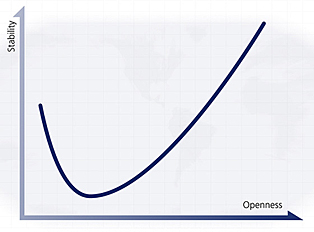
If you want to get a good feeling for how kooky the whole neocon outlook is, I recommend reading about the J curve:

The idea is that by introducing instability to a repressive regime, you initially make things worse in terms of both stability and openness, but then, once you hit rock bottom on both, you start to get better on both. This explains why it’s a good idea to completely destabilize countries, rather than hope for any kind of gradual reform.

Let me pose the following question: has any policy good ever come from the discussion of curves? Laffer curve, Bell curve, J curve. What is it about a picture of a curve that strips all intelligence and reason out of a discussion?

My guess is that they have mystical pull which leads people to believe they encapsulate some general truth that EXPLAINS EVERYTHING, the same way that the writings of Adam Smith, Ayn Rand, and the Founding Fathers do, only better, because graphs are more both more reductionist and more faux scientific.

Update. In the interest of fairness and accuracy, I should include framing as one of the things that EXPLAINS EVERYTHING. There’s no need to be too partisan about this.

Update. Commenter Redshift makes a good point:

I think the mindset behind these “curves” is similar to that of various “doctrines”; the problem comes from the belief that the curve itself is a fundamental truth, rather than an illustration of underlying data (which can then be debated, falsified, etc.) This is why they are always shown with no units, not even at the maximum. For example, the Laffer curve shows the no-brainer that there is a level of taxation where it is possible to cut taxes and raise revenue; take away the scale, and you can make the argument that cutting taxes from where we are now raises revenue (if you’re either intellectual dishonest or in the throes of confirmation bias.)

Compare this to the so-called “hockey stick” global warming graph. To scientists, this is just an illustration of data, and the underlying data is what’s up for debate. To wingnuts, it’s a major point of debate; if they can “prove” that it is in any way incorrect, then global warming is a lie.

Benen: 'SUPREME LEADER'....
In his Washington Post column the other day, Charles Krauthammer expressed his outrage that President Obama referred Ayatollah Ali Khamenei as the "Supreme Leader" of Iran. "'Supreme Leader'?" Krauthammer asked indignantly. "Note the abject solicitousness with which the American president confers this honorific on a clerical dictator."

This line of attack seems to be catching on, at least a little, in conservative circles. Yesterday on CNN, Bill Bennett added:

"We should be on the side of freedom, and not on the side of this, our 'supreme leader,' as our president keeps referring to."

This is really silly. Krauthammer and Bennett may be annoyed by the use of the title, but they're being awfully selective in how they apply their disgust.

The same days as Krauthammer's column ran, for example, John McCain was on Fox News when he said, "There may be those indications since the Supreme Leader said that they were not going to tolerate further demonstrations in the street." Does this count as "abject solicitousness," too?

Likewise, Media Matters added, "[T]he Bush State Department, and conservatives, including The Weekly Standard's Bill Kristol, and Republican Sens. John McCain and Richard Lugar, have also 'referred to' Khamenei as Iran's 'supreme leader.'"

The right should at least start taking a little more time to think their criticisms through. Throwing everything at the wall to see what'll stick is hardly a sound rhetorical strategy.

Think Progress: Scarborough Lambastes McCain And Graham On Iran: They’re ‘So Shortsighted I Find It Stunning’

Since the disputed June 12 presidential election in Iran, Sen. John McCain (R-AZ) has been routinely criticizing President Obama’s response to the crisis. Yesterday on CBS’ Face the Nation, McCain echoed the GOP’s party line, saying “the United States hasn’t done anything” and sought fervently to cast Obama’s actions as “tepid.” Appearing on ABC’s This Week, Sen. Lindsay Graham (R-SC) demanded that Obama “lead the free world and not follow it.”

But this morning on MSNBC’s Morning Joe, host Joe Scarborough broke ranks and called the senators’ criticism “an exercise in doing things that make us feel good about ourselves” while labeling it “outrageous.” Scarborough — called the “new face” of the GOP by Christopher Buckley — went on to say that those rebelling in Iran would be punished more severely if Obama were to follow McCain’s advice:

SCARBOROUGH: All we would do is undermine those people in the street, who the second that they are attached to the United States of America, the country after all that’s been known in Iran as the great Satan since 1979, we will undermine their cause … It’s so shortsighted I find it stunning. […]

What would John McCain and Lindsey Graham specifically have the president say? All of those people that are emailing in and telling me that I’m being liberal? Oh really? I’m being liberal? No I think it’s called restraint. Showing a little bit of restraint. Looking at the battlefield in front of you and not just running up Pickett’s Charge and getting gunned down. If you want to feel good about yourself — and you can only feel good about yourself by screaming about the evils of Iran — fine do that. But our leaders in Washington don’t need to do that because people will be routed in the street the second they are identified with the United States of America.

Watch it:


Despite McCain and Graham’s claims to the contrary, Obama has expressed U.S. disapproval of the Iranian government’s actions. Obama released a statement on Saturday condemning the violation of human rights while steering clear of the politics. In an interview with CBS’ Early Show this morning, Obama responded similarly to Scarborough, saying the U.S. has to guard against being used as a scapegoat by the Iranian regime:

“The last thing that I want to do,” the president said, “is to have the United States be a foil for — those forces inside Iran who would love nothing better than to make this an argument about the United States. That’s what they do. That’s what we’ve already seen. We shouldn’t be playing into that. There should be no distractions from the fact that the — Iranian people are seeking to — let their voices be heard.

McCain and Graham are growing increasingly isolated, as Republicans in Congress and conservatives in the media endorse Obama’s measured response.

  • Sully adds his Quote For The Day
    "OK, let me see if I've got this right. Since Barack Obama has taken the presidential oath of office we have witnessed: a) Hezbollah lose a shoo-in election in Lebanon, b) Pakistan begin serious efforts to control the Taliban and al Qaeda elements inside its borders, c) Netanyahu of Israel mumble support about a two state solution and rethink settlements and, d) A major awakening of the Iranian citizenry against the heavy-handedness of the mullahs. What hasn't changed? The simple-minded thuggery of the Right when it comes to foreign policy (and Grover Norquist, someone should gently remind him that it's 2009, not 1989). They have long preferred a modified Teddy Roosevelt approach. Speak loudly and wail away with the biggest stick you can find. I don't know if all this is the results of one speech in Cairo by the President but if it is I hope he gives a second, and soon," - Carl Owen, Politico.

Memo Reveals US Plan to Provoke an Invasion of Iraq
http://www.truthout.org/062209J?n
Jamie Doward, Gaby Hinsliff and Mark Townsend, The Observer UK: "A confidential record of a meeting between President Bush and Tony Blair before the invasion of Iraq, outlining their intention to go to war without a second United Nations resolution, will be an explosive issue for the official inquiry into the UK's role in toppling Saddam Hussein. The memo, written on 31 January 2003, almost two months before the invasion and seen by the Observer, confirms that as the two men became increasingly aware UN inspectors would fail to find weapons of mass destruction (WMD) they had to contemplate alternative scenarios that might trigger a second resolution legitimising military action."

Health Care - Time for Action

Time for action folks. If we want meaningful health care reform in this country, and the polls overwhelmingly say we do, then we are going to have to make our elected reps serve our interests instead of moneyed special interests. - Get involved. Call and write your representatives. If a march can be organized in DC, be there.

Karen Tumulty: When Health Insurance Isn't Health Insurance (Cont'd.)

Paul Begala took note of our post the other day about some terribly tragic health insurance stories that had been told before the House Energy and Commerce subcommittee on oversights and investigations. And he pointed out something else:

It was as dramatic as congressional testimony gets. Yet it got no airtime on the networks, nor, as far as I can tell, on cable news, although CNN.com did run a story. Time's Tumulty was all over it, as was Lisa Girion of The Lost Angeles Times. But the story did not make The New York Times.

Nor The Washington Post, which found space on the front page the morning after the hearing for a story on the cancellation of Fourth of July fireworks in Shippensburg, Pennsylvania, but not a story on the cancellation of health insurance for deathly ill Americans who've paid their premiums.

Stupak, and the Energy and Commerce Committee chairman, Henry Waxman, D-California, did their job. Why didn't the media do its? Why were the outrages uncovered by Stupak and Waxman un-covered by most of the media?

The more I thought about it, the more I realized what a missed opportunity this had been. There's no way I could possibly tell Robin Beaton's story nearly as powerfully as she did herself. So I asked C-SPAN's omnipotent Howard Mortman to dig up the clip out of their video library. Please watch this. It could happen to you or to someone you love.:


Christy Hardin Smith: Healthcare And The Economy: Time To Put The Public Back In The Policy

Digby points to a Catherine Rampel piece at NYTimes. In it, Rampel underscores a universal political truth:

According to two recent polls from The New York Times/CBS News and The Wall Street Journal/NBC News, Americans appear very worried about controlling the federal deficit.

...that most Americans put a higher priority on keeping the budget deficit down than on spending more money to stimulate the economy.

Creation of perception makes your political reality come to life, including through carefully Luntzian-crafted questions and manipulation of the after-messaging, regardless of the underlying facts and hard numbers.

Rinse, lather, repeat.

But only if we let it, as Digby aptly points out:

The fiscal scolds don't stop when the numbers turn around. They keep up the fear mongering because it isn't really about balanced budgets or paying down debt. It's about keeping government from bringing positive results to the people. As long as they can keep people focused on debt, whether it exists or not, they always have the rationale to stop any sort of government action that could empower average citizens.

And thus we come back to the question I find myself asking over and over again when mouths yap up and down about the "good of the country" and "too big to fail" and "the market will sort it out" -- what's in it for the person whose gums are flapping?

What skin do they have in the game? What promotional interest or PR ploy or electoral backscratch is involved on the down low?

Krugman has a piece on the health-care-palooza traveling carnival show we've all been watching. And Paul asks the question I keep asking myself:

If I had to guess, I’d say that what’s really going on is that relatively conservative Democrats still cling to the old dream of becoming kingmakers, of recreating the bipartisan center that used to run America.

Bipartisan zombies must go.

At what point does the public's interest get put back into the policy? As Yglesias says, the public option still has overwhelming support from the...public.

From the Blue Dogs, the well-heeled lobbyists, the suits and well-bonused fatcats....the elected officials who seem more interested in "what's in it for me" and whether the public gets the shaft? That's pretty much an empty bench when it comes to the public's interest these days, isn't it?

I don't know the answer on how to fix this, but I'm sick and tired of just being so pissed at the wasteful, self-serving bullshit.

John Anderson's wonderful piece on the Pecora Commission keeps haunting me:

To an extraordinary degree, in the halls of Congress, the conspiracy of silence continues to protect sinners on both sides of the aisle. That it is patently obvious that there are more sinners on one side of the aisle than the other doesn’t seem somehow important enough to alter the equation.

And so, as it was not quite 80 years ago, and as it was again in 1973, someone—some one man, some one woman—must break the logjam if ever we are to get at the truth.

I'm sick of waiting for the man (YouTube). Let's find a way to force the public back into the policy. Now.

Benen: THE RISK TO REFORM....

On CNN yesterday, Sen. Dianne Feinstein (D) of California commented on the state of the debate over health care reform: "To be candid with you, I don't know that [President Obama] has the votes right now." She added, "I think there's a lot of concern in the Democratic caucus."

In context, Feinstein wasn't exactly lamenting the current state of affairs. In other words, she wasn't suggesting, "There's a lot of concern among Democrats, but I hope to convince them that reform efforts are sound and necessary." Rather, Feinstein made it sound as if she's discouraged by the entire initiative.

Paul Krugman made it clear in his column today that it's senators like Feinstein who will either deliver on reform or kill it. Republican lawmakers, by and large, do not even want to play a productive role in the process. Progressive Democratic lawmakers are moving forward with a strong plan, which includes a public health insurance option that competes with private insurers and keeps costs down. And then, there are the "centrists."

The real risk is that health care reform will be undermined by "centrist" Democratic senators who either prevent the passage of a bill or insist on watering down key elements of reform. I use scare quotes around "centrist," by the way, because if the center means the position held by most Americans, the self-proclaimed centrists are in fact way out in right field.

What the balking Democrats seem most determined to do is to kill the public option, either by eliminating it or by carrying out a bait-and-switch, replacing a true public option with something meaningless. For the record, neither regional health cooperatives nor state-level public plans, both of which have been proposed as alternatives, would have the financial stability and bargaining power needed to bring down health care costs.

Whatever may be motivating these Democrats, they don't seem able to explain their reasons in public.

Thus Senator Ben Nelson of Nebraska initially declared that the public option -- which, remember, has overwhelming popular support -- was a "deal-breaker." Why? Because he didn't think private insurers could compete: "At the end of the day, the public plan wins the day." Um, isn't the purpose of health care reform to protect American citizens, not insurance companies?

Over the weekend, we learned that the idea of a public option enjoys 72% support -- including 50% of Republicans -- in the latest NYT poll. It followed an NBC/WSJ poll that showed 76% of Americans believing that it's important to "give people a choice of both a public plan administered by the federal government and a private plan for their health insurance." What's more, a D.C. policy think tank conducted a poll, financed in part by previous opponents of health care reform, which found 83% of Americans favor a public plan.

The president is ready. The House is ready. The public is ready. The times demand that Senate Democratic "centrists" step up. Will they answer the call?

  • Joe Sudbay (DC) adds:
    Krugman deconstructs the blather coming from Senators Ben Nelson (D-NE) and Kent Conrad (D-ND), concluding:
    Honestly, I don’t know what these Democrats are trying to achieve. Yes, some of the balking senators receive large campaign contributions from the medical-industrial complex — but who in politics doesn’t? If I had to guess, I’d say that what’s really going on is that relatively conservative Democrats still cling to the old dream of becoming kingmakers, of recreating the bipartisan center that used to run America.

    But this fantasy can’t be allowed to stand in the way of giving America the health care reform it needs. This time, the alleged center must not hold.
    Something happens on Capitol Hill that makes people lose all sense of reality. As Chris noted yesterday, the latest NY Times/CBS poll showed "72% support" for the public option. That's very significant. But, Democratic Senators, like Ben Nelson, Kent Conrad, Max Baucus, Joe Lieberman and Mary Landrieu, would rather make friends with Republicans than provide the American people a decent system for health insurance. That's despicable -- and they're going to undermine a key piece of the Democratic agenda. The American people actually expect elected officials to deliver on campaign promises.
DougJ: Rich enough for tax cuts, too poor for health care

The Official Washington Talking Point against health care reform seems to now be that it is too expensive (here; here). Krugman points out:

Yes, the Congressional Budget Office’s preliminary cost estimates for Senate plans were higher than expected, and caused considerable consternation last week. But the fundamental fact is that we can afford universal health insurance — even those high estimates were less than the $1.8 trillion cost of the Bush tax cuts.

The CBO numbers ($1.6 trillion) were also about half of the estimated long-range costs of the Iraq war.

Don’t get me wrong, I think that it’s very important that health care reform be fiscally responsible, but where the hell was all this consternation when we were invading Iraq (even at the time, some experts were estimating costs as high as $1.6 trillion—see James Fallows’ definitive “Blind Into Baghdad“)? Where was it when we were running $300 billion deficits during an economic expansion?

Liberals have often claimed complained that our government has plenty of money for tax cuts and wars, but never enough for education and health care. And it’s easy to turn that into an a preachy slogan or bumper-sticker.

But at a certain point, everyone should admit that it is true.


Karen Tumulty: The Health Care Co-Op Idea
This idea has gained some traction on Capitol Hill as an alternative to a public plan. Kate Pickert takes a look at how health care cooperatives might work, and discovers that their experience in the real world isn't very encouraging.
  • Yglesias: Schumer: Co-Ops are No Substitute for Public Option

    CBS News reports that some Democrats are feeling emboldened by recent polls showing overwhelming public support for providing people with a public-sector alternative to for-profit health insurance.

    Behind-the-scenes attempts to get a deal with Republicans on nonprofit co-ops as an alternative to a public plan have led only to frustration, complains a key Democrat. He and his colleagues may have to go it alone, said Sen. Chuck Schumer. The co-ops were seen as perhaps the last hope for compromise on a contentious issue that threatens any remaining prospects of bipartisan support for President Obama’s sweeping plan to remake the health care system.

    “I don’t think I could say with a straight face that this (co-op proposal) is at all close to a nationwide public option,” Schumer, D-N.Y., told The Associated Press on Sunday. “Right now, this co-op idea doesn’t come close to satisfying anyone who wants a public plan.”

    I think this is arguably the virtue of having different kinds of bills wending their way through congress. I think a robust public option is very important. But there are a lot of moving parts to health reform, and it’s not the only important thing. The bill the Senate Finance Committee’s written, which has no public plan but does have a lot of virtues, provides an important test. Will Republicans actually flock to support the bill? If they will, then that’s something worth thinking about. A public plan is important, but if you could get leading Republicans to sign on to the idea of tough new regulations on insurers, on an expansion of Medicaid, on subsidies to ensure that insurance is affordable for everyone, and on higher taxes to pay for the whole thing that would be no small achievement. You’d have to think seriously about whether it isn’t worth cutting a deal. But thus far, for all the whining about the public plan I’m not seeing the evidence that they’re actually willing to embrace the rest of the health reform agenda, either. In which case, you may as well go forward with a robust public plan. And I think it’s important for Democrats to stop hiding behind Republicans on this. People who say they’re leery of a public plan because they want a bipartisan bill need to either produce some Republicans who are willing to support their ideas, or else admit that it’s they themselves who are blocking the public option.

  • Steve Benen adds:

    Schumer has not always been a consistent progressive champion, but by all appearances, he's showing some real leadership on this issue right now. To his credit, Schumer even rejected the co-op proposal gaining steam among Republican and "centrist" Democrats: "I don't think I could say with a straight face that this (co-op proposal) is at all close to a nationwide public option. Right now, this co-op idea doesn't come close to satisfying anyone who wants a public plan."

    What's more, the recent polls are giving Schumer a hand in pressing his colleagues: "The polling data backs up our subjective view that to make health care reform work, you need a public option."

    It leads to a test for the Senate caucus: back an effective plan that enjoys public support, or pursue an inferior bipartisan alternative.

    We know Senate Republicans have said a plan option is a step they are simply unwilling to take. We also know that for Democratic "centrists," GOP opposition has them scrambling for plausible alternatives.

    But E.J. Dionne recently posed some questions that these "centrists" should ponder: "Where did we get the idea that the only good health-care bill is a bipartisan bill? Is bipartisanship more important than whether a proposal is practical and effective? And if bipartisanship is a legitimate goal, isn't each party equally responsible for achieving it? ... It's one thing to compromise to pick up votes, which, one hopes, is what Baucus is doing. It's another to compromise in exchange for nothing at all. The first is bipartisanship with a purpose. The second is the bipartisanship of fools."

A friend offers the following perspective:
Three points about “health care reform”:

First, no one is talking about how many Americans are ALREADY on Federal health care, with the government as payer. These would include ALL US military and their families, ALL retired US military and their families, ALL federal employees and their families, active and retired whether Executive, Legislative, or Judicial branches, ALL Medicare and Medicaid recipients, ALL Federal prisoners.

Toss in ALL state and local government employees, and it's a heck of a large number. NO ONE IS TOTALLING THIS CROWD!

If you put the UNINSURED on ONE side, and the GOVERNMENTALLY INSURED on the other, who's left? Let's see the numbers!

Second, the President has already endorsed the Federal Direct Student Loan Program, originated and operated by civil servants in the Department of Education. This is because it's simpler, cheaper, and probably fairer. The parallels with single payer health insurance are PALPABLE, but NO ONE is talking about them. Why not?

Third, and very important, SENATORS AND CONGRESSMEN receive VERY GENEROUS health care benefits, and are not taxed for them, and they're paid for BY THE GOVERNMENT, and WHO ARE THEY to deny similar benefits to others? Are they THAT MUCH BETTER THAN WE ARE??

It is important to keep mentioning all three points, especially the last, because we need to open the OVERTON WINDOW to a wider public discussion! Check it out! Get with it!!
  • From Wikipedia: Overton window
    The Overton window is a concept in political theory, named after its originator, Joe Overton, former vice president of the Mackinac Center for Public Policy. It describes a "window" in the range of public reactions to ideas in public discourse, in a spectrum of all possible options on an issue. Overton described a method for moving that window, thereby including previously excluded ideas, while excluding previously acceptable ideas. The technique relies on people promoting ideas even less acceptable than the previous "outer fringe" ideas. That makes those old fringe ideas look less extreme, and thereby acceptable. The idea is that priming the public with fringe ideas intended to be and remain unacceptable, will make the real target ideas seem more acceptable by comparison.
Ezra Klein: Public Wants Fewer Jobs, More Severe Recession

The NBC/Wall Street Journal poll that emerged last week got a lot of attention for finding that 76 percent of Americans think the choice of a public plan is important for health reform. That cheered progressives, for obvious reasons. But looking through the whole poll, there's actually quite a bit that augurs poorly for Obama's agenda. Check out this bit on priorities, for instance:

priorities.jpg

Elsewhere, 58 percent think that "the President and the Congress should worry more about keeping the budget deficit down, even though it may mean it will take longer for the economy to recover." Fifty-three percent think the government was wrong to bail out Chrysler and GM. A 39 percent plurality thinks the stimulus was a bad idea.

This isn't, of course, the first time that the American people have had pretty terrible opinions about how to handle the economy. Paul Krugman dug up some striking numbers from 1935 showing that 70 percent of Americans wanted the Roosevelt administration to balance the budget, and the White House, heeding public opinion, promptly contracted its economic policy and tossed the country into the brutal 1937 recession.

Which is to say, there are three ways of reading this poll. One is to say that Americans are concerned with federal spending and government intervention. Another is to say that Americans don't understand macroeconomics. And another is to say that Americans want a radically higher unemployment rate and a much more severe recession.

Which gets to one of the difficulties posed by this sort of poll. The obvious way to report the results is that the public is growing skeptical of Obama's agenda. But for all that, the public is pretty likely to also respond negatively to an economic collapse. A poll can tell you a lot about what a voter doesn't like in this reality. It's not always so good about distinguishing between the relevant alternatives. That, in theory, is David Axelrod's job.

digby: 1996

Over at the Economix blog at the NY Times, Catherine Rampell took a look at the correlation between actual government deficits over the years and how the public perceived them, according to the Gallup poll:


If public worries about the nation’s fiscal health were perfectly related to the nation’s actual fiscal health, these two charts should be near-mirror images of each other.

That is, when the deficit represents a higher percentage of G.D.P. (i.e., the red bars pointing downward get longer), you should see more people naming the federal budget as the country’s most pressing issue (i.e., the blue bars going upward should also get longer).
Read the whole post for a long explanation and many caveats about these numbers and why they should be taken with a grain of salt, even if they are interesting.

I am interested more in the fact that the public obsession with the deficit tracks very closely with the rise of the anti-tax conservative movement, actually peaking at a time when the deficit was in very serious retreat and turning into surplus. Large numbers of people still believed it was rising.

The fiscal scolds don't stop when the numbers turn around. They keep up the fear mongering because it isn't really about balanced budgets or paying down debt. It's about keeping government from bringing positive results to the people. As long as they can keep people focused on debt, whether it exists or not, they always have the rationale to stop any sort of government action that could empower average citizens.

It's no mystery why George W. Bush was so anxious to spend that surplus he inherited as soon as possible, or why Alan Greenspan actually said that surpluses were dangerous to the economy. Their whole program is undermined if people aren't living under the impression that the economy is hamstrung by so much debt that the whole thing is in danger of coming apart at the seams if they don't (perversely) keep cutting taxes and cutting spending. People hear that enough, they just absorb it and it becomes conventional wisdom.

Deficits are an abstract concept that people end up using it as a proxy for "financial responsibility" which is extremely imprecise, since the government is responsible for a whole lot of things besides the budget. But until somebody comes up with something that makes more sense to average folks, the deficit boogeyman will be a powerful symbol that can be used by both parties to keep the government from challenging the status quo.

What Glenn said . . .

Greenwald

UPDATE III: Referencing the Froomkin essay I posted the other day on the (abdicated) duty of journalists to "call bullshit" on government officials, Law Professor Kevin Jon Heller recounts a conversation he had this week with a high British government official:

It’s difficult not to feel despair at the increasing banality of journalism in the US. A couple of days ago, I had the privilege of spending the evening with Lord Carlile of Berriew, who has served as the UK’s Independent Reviewer of Terrorism Legislation since 9/11. He has no binding authority, but he insisted that his power to "name and shame" gives him a great deal of actual influence over the content of antiterrorism legislation. And indeed, it seems clear that many of the UK’s imperfect antiterrorism laws would have been far less perfect but for his efforts.

I found Lord Carlile’s discussion of his "soft power" fascinating, so I asked him why he thinks the power to name-and-shame has almost no effect in the United States, where those who are named as the intellectual authors of repressive legislation feel no shame and suffer no consequences for their actions. He gave a very simple answer: journalists. I won't repeat some of the words that he used to describe just how pathetic he considers US political journalism, but it’s clear that he believes it has completely abdicated its duty to — as Froomkin describes it — call bullshit on the government.

There are many reasons why establishment media discussions of our political conflicts are so incomplete, distorted, vapid and unsatisfying. But one significant reason is that one of the most important causes of our decayed political culture is a topic which is excluded almost completely from those discussions: namely, the central role the establishment media itself -- with its uncritical and loyal subservience to political power -- plays in enabling and protecting that decay.

Sunday, June 21, 2009

Media Malfeasance

Boehlert: Worst false equivalency of the week

Courtesy of this USA Today headline:

Poll: Obama down, Cheney up

The regrettable lede:

A new NBC/Wall Street Journal poll shows President Obama's favorability ratings still sky-high but slipping slightly, while former vice president Dick Cheney, seen here during at recent appearance at the National Press Club, appears to be improving his image.

Not only does the newspaper continue to group Obama and Cheney in as equals, the way the press did during the recent flare-up over national security, but USA Today draws a direct comparison between their polling numbers, with the obvious conclusion that Cheney's getting the better of Obama; that the former VP's "up" while Obama is "down."

Notes the daily:

As our Gannett Washington Bureau colleague Chuck Raasch recently pointed out, the former veep has been on a full-court public relations press lately defending the foreign policy and national security efforts of his boss, former president George W. Bush.

Score one for Cheney!

But what exactly did the the NBC/WSJ poll reveal about both [emphasis added]?

Of those responding, 60% had a very or somewhat positive view of the president, compared with 66% in January, when Obama took office. Cheney's numbers moved up from 21% in December to 26% today.

Wow, Cheney's up five points in six months and remains nearly one-third as popular as Obama. He's on a roll!


Stoopid Wingnut Tricks

Before the stoopid begins, here's some smart from our President on Father's Day:


John
Cole: Give ‘em enough thread…

And our commenters will usually sum things up better and more succinctly than I can. I’ve been mulling writing something about the neocons’ constantly shifting attitude towards the events in Iran and their bizarre claims (here; here; via) that Bush’s Freedom Agenda is what set all the good things going on in Iran into motion, but ninerdave has already said it all:

What is funny to me is the wingnuts rooting for an overthrow of Ahmadinejad at the same time the wingnuts are rooting for an Ahmadinejad win. All of this is without acknowledging Mousavi, was one leader in the Islamic revolution. He’s not going to be some liberal, DFH that the wingnuts think he is. Nor is he going to be the flaming hate monger Ahmadinejad is.

OF course no matter what the outcome: Obama fucked it up and the NeoCons were right. This will be played out on the Sunday talk shows for a while and also.

I don’t think that’s an exaggeration at all. Here’s what Ari Fleischer actually said:

No one yet knew the final outcome, he wrote in an e-mail to our colleague Glenn Kessler, but “one of the reasons there is a substantial reform movement in Iran — particularly among its young people — is because of George W. Bush’s tough policies.” He noted that Bush’s policies in Lebanon also helped in the recent elections there. …

So “I think it’s fair to say the George Bush’s Freedom Agenda planted seeds that have started to grow in the Middle East,” Fleischer concluded.

In other words: no matter what happens, it proves that Bush was right.

  • Benen: DO THEY KNOW THE OTHER SIDE EXISTS?...

    I'll give the Weekly Standard credit for clarity. The conservative magazine published two very similar pieces today -- one from Stephen Hayes and William Kristol, the other from Fred Barnes -- offering the identical attack with indistinguishable language: they want President Obama to do more to intervene in Iran.

    The pieces are almost comical in their belligerence towards the White House. Hayes and Kristol lament Obama's "weakness," and described the U.S. president as "a de facto ally of President Mahmoud Ahmadinejad and Supreme Leader Ali Khamenei." Barnes insists, "Obama has tilted in favor of the regime. The result is personal shame (for Obama) and policy shame (for the United States)."

    What I find interesting about the 2,000 words of the conservatives' angry and righteous denigration is how remarkably narrow it is. For Hayes, Kristol, and Barnes, it's almost as if the argument presented by the president is so self-evidently horrible, they don't feel the need to explain why they think it's wrong.

    By now, we've all heard the pitch. Obama believes it would be counterproductive for Iranian protestors for the U.S. to intervene on their behalf. The more Americans weigh in to "help" reformers, the more it's likely to help Khamenei and Ahmadinejad -- throwing them a public-relations life preserver when they need it most -- and the easier it is to make dissidents look like American stooges.

    Gary Sick, a former National Security Council expert on Iran in the Ford, Carter and Reagan administrations -- not, in other words, a liberal activist or party hack -- explained the other day, "The Obama administration has handled this pretty well. There's nothing we can do in a proactive way that is going to improve things. We could make things a lot worse."

    It's a position endorsed by other Republicans such as Dick Lugar and Henry Kissinger. Nick Burns, an Undersecretary of State in the Bush administration, said this week that Ahmadinejad "would like nothing better than to see aggressive statements, a series of statements, from the United States which try to put the U.S. at the center of this."

    Why do the neocons believe this is a misguided approach? We don't know; they won't say. Jon Chait noted yesterday:

    What's remarkable to me is that those on the other side refuses to rebut it. Today's Washington Post op-ed page has two more columns lambasting Obama for failing to embrace the demonstrators. Today's offerings are by Charles Krauthammer and Paul Wolfowitz. Neither one of them even mentions, let alone answers, Obama's argument for why embracing the demonstrators would be counterproductive.

    I don't understand how you could write a column without ever once addressing the primary argument for the proposition you're arguing against. The low quality of argument on this topic from the right is striking.

    Chait's criticism of Krauthammer and Wolfowitz applies just as easily to Hayes, Kristol, and Barnes. All five of them are so focused on attacking Obama, they never quite get around to refuting the argument from the president they find so offensive.

    Is the administration's position justified? Is it sensible? Might it be the responsible approach under the circumstances? The strategy is not above reproach, but the Weekly Standard neocons just won't, or can't, challenge the policy. It's bizarre.


Benen: THE 'HEAD-KNOCKING STYLE OF GOVERNANCE'....
RNC Chairman Michael Steele offered his perspective yesterday on how policymakers can reach agreement on reforming the health care system. It's easy to mock his rhetoric, but it's worth remembering how common this kind of thinking is in Republican circles.

"[I]f it's a cost problem, it's easy: Get the people in a room who have the most and the most direct impact on cost, and do the deal. Do the deal. It's not that complicated.

"If it's an access question, people don't have access to health care, then figure out who they are, and give them access! Hello?! Am I missing something here?

"If my friend Trevor has access to health care, and I don't, why do I need to overhaul the entire system so I can get access he already has? Why don't you just focus on me and get me access?"

Now, it's obvious from these remarks that Steele is clueless. He's so lost, I almost feel bad for the guy. That said, hearing Steele's "do the deal" remarks, it reminded me of the same, intellectually lazy approach we've heard from Republicans on a wide variety of issues.

In 2006, John McCain explained his solution for the war in Iraq: "One of the things I would do if I were President would be to sit the Shiites and the Sunnis down and say, 'Stop the bullshit.'" Around the same time, George W. Bush reflected on a solution for violence in Lebanon: "What they need to do is to get Syria, to get Hezbollah to stop doing this shit and it's over."

Last year, McCain explained that we could resolve FISA-related controversies by having "patriotic Americans ... sit down together and work this out." A month before the presidential election, McCain said he had a plan to address Social Security issues: "We've got to sit down together across the table."

And now Steele thinks policymakers can resolve complex health care issues if they simply "do the deal" and "give" Americans "access."

Digby once famously described this as the "head-knocking style of governance" -- complex problems can be resolved through force of will, because Republicans say so. Nuances, history, competing goals, divergent ideologies -- nothing matters except "doing the deal."

I realize it's nice to think well-intentioned people can sit down in a room and resolve complex issues, but if policymakers could snap their fingers and fix historic challenges, they would. For those of us above the age of 11 who try to take government seriously, it's just not that easy.

  • Joe Sudbay (DC) adds, about the Sunday Talk Shows lineup:
    Iran and health care appear to be the topics du jour.

    John "bomb, bomb Iran" McCain gets two opportunities to push his view that the U.S. should do more (even though most experts seem to think that would backfire in Iran.) No doubt, McCain's lackey, Lindsey "the sinner" Graham, will echo his words.

    On health care, maybe some of the Senate Democrats can explain how they're going to stop screwing up real reform.

    Here's the lineup:C's "This Week" — Sens. Chris Dodd, D-Conn., and Lindsey Graham, R-S.C.; former Labor Secretary Robert Reich.

    ___

    CBS' "Face the Nation" — Sen. John McCain, R-Ariz. ...

Benen: WHEN IDEOLOGY TRUMPS LAW ENFORCEMENT....

Newsweek had an item the other day that I found a little startling.

In February, the Missouri Information Analysis Center, one of several "fusion" centers created after 9/11 to share intelligence among local, state and federal agencies, issued a "strategic report" warning about a resurgence of the "modern militia movement." Last week, on the same day that white supremacist James von Brunn allegedly killed a guard at Washington's Holocaust Memorial Museum, Missouri's police chief informed legislators that the fusion center had suspended production of such reports. Why? Outcry from conservative activists, who felt they were being tarred too. [...]

They may talk about it less in public now, but law-enforcement and intel officials tell NEWSWEEK they're quietly scrutinizing threats from the far right just as carefully as those from Islamic extremists.

So, let me get this straight. Law enforcement officials decided, on purpose, to stop preparing reports on potentially dangerous radicals, because conservative activists said scrutiny of extremists made them feel put upon? Conservative activists whine about all kinds of things; shouldn't law enforcement officials ignore them and focus on real threats?

Thankfully, it appears their fear has subsided, and officials are back to taking these extremists seriously again. Given recent events, that's obviously a good thing. As awful as the tragedies in Kansas and D.C. were, if law-enforcement and intel officials are back to "scrutinizing threats from the far right" without undue fears of conservative criticism, that's a good thing.

  • From the comments:

    People are going to have to care a whole lot less what conservatives say or how they feel about a lot of things.

    Posted by: Varecia on June 21, 2009 at 9:44 AM

Speaking of people needing to care a whole lot less about what conservatives think . . .
Benen: SOMETHING TO STIFFEN SOFT SPINES....
Politicians tend to care about polls. Other considerations may apply pressure to an office holder, but nothing is quite as effective as cold, hard data pointing to public attitudes. When push comes to shove, popular ideas are much easier for a policy maker to support than unpopular ones.

In the context of the debate surrounding a public option in health care reform, lawmakers on the Hill may not care that President Obama wants such a provision and has a mandate to get one, but the recent poll numbers are so one-sided, the results should be hard for Congress to ignore.

An NBC/WSJ poll released the other day found that 76% of Americans believe it's either "extremely important" or "quite important" to "give people a choice of both a public plan administered by the federal government and a private plan for their health insurance."

The wording of that question was a little awkward, though. The results from the latest NYT poll are even more encouraging.

Americans overwhelmingly support substantial changes to the health care system and are strongly behind one of the most contentious proposals Congress is considering, a government-run insurance plan to compete with private insurers, according to the latest New York Times/CBS News poll.

The poll found that most Americans would be willing to pay higher taxes so everyone could have health insurance and that they said the government could do a better job of holding down health-care costs than the private sector.

Respondents were asked, "Would you favor or oppose the government's offering everyone a government administered health insurance plan like Medicare that would compete with private health insurance plans?" It wasn't even close -- 72% supported the public option. Among Republicans, the ones who are supposed to find the very idea of a public plan so outrageous, 50% favor the same policy idea.

Now, for conservative Republican lawmakers, it's likely that none of this matters. A public option can save money, can enjoy broad public support, and can make all kinds of sense, but they have a philosophical objection that trumps everything else. Fine.

But conservative Republicans represent a fairly small minority in Congress right now. For those Democrats who are reluctant to support a public plan, the concerns may be strategic -- they're worried that they'll be punished by voters for supporting a controversial idea. But that's precisely why a poll like this matters. It's not like Ben Nelson, Joe Lieberman, and Evan Bayh can go to the next caucus meeting and say, "If we support an idea with 72% national approval, voters will kill us."

The president wants a public option. A majority of the House wants a public option. It's likely a majority of the Senate wants a public option. A clear majority of Americans want a public option. Oh, and not incidentally, a public option makes a lot of sense as a matter of public policy.

I don't know what more it would take to stiffen the spines of wavering Democratic senators who just can't seem to bring themselves to do what needs to be done.

Bill Maher's AMA Commercial


DemfromCT
(DK):
Your Abbreviated Pundit Round-up

Sunday punditry, with a twist of revolution.

Frank Rich:

That First 100 Days hoopla seems like a century ago. The countless report cards it engendered are already obsolete. The real story begins now. With Iran, universal health care, energy reform and the economic recovery all on the line, the still-new, still-popular president’s true tests are about to come.

Here’s one thing Barack Obama does not have to worry about: the opposition. Approval ratings for Republicans hit an all-time low last week in both the New York Times/CBS News and Wall Street Journal/NBC News polls. That’s what happens when a party’s most creative innovations are novel twists on old-fashioned sex scandals.

Michael Gerson: Count me in as another fighting keyboarder who demands Obama side with freedom fighters at risk for getting themselves killed.... from my living room. When I was with the Bush administration, look how effective we were in using "Freedom" in every speech. Stop listening to dinosaurs like Kissinger, and get out there and agitate.

Roger Cohen [added]:

Khamenei has taken a radical risk. He has factionalized himself, so losing the arbiter’s lofty garb, by aligning himself with President Mahmoud Ahmadinejad against both Mir Hussein Moussavi, the opposition leader, and Ali Akbar Hashemi Rafsanjani, a founding father of the revolution.

George Will: Obama is attempting to use health reform to destroy insurance companies. I can prove it by pointing to rabid anti-insurance picks like Tom Daschle and Katherine Sebelius. And by fudging the uninsured to make them look feckless and transient. And by making reform go away with tax credits. And by using Occam's Razor. Of course, Occam's Razor suggests that the simplest explanation is that I don't understand the topic.

...

Sully: Why Froomkin Was Fired

"Mainstream-media political journalism is in danger of becoming increasingly irrelevant, but not because of the Internet, or even Comedy Central. The threat comes from inside. It comes from journalists being afraid to do what journalists were put on this green earth to do…

Calling bullshit, of course, used to be central to journalism as well as to comedy. And we happen to be in a period in our history in which the substance in question is running particularly deep. Calling bullshit has never been more vital to our democracy. It also resonates with readers and viewers a lot more than passionless stenography I’m not sure why calling bullshit has gone out of vogue in so many newsrooms — why, in fact, it’s so often consciously avoided. There are lots of possible reasons.

There’s the increased corporate stultification of our industry, to the point where rocking the boat is seen as threatening rather than invigorating. There’s the intense pressure to maintain access fo insider sources, even as those sources become ridiculously unrevealing and oversensitive. There’s the fear of being labeled partisan if one’s bullshit-calling isn’t meted out in precisely equal increments along the political spectrum.

If mainstream-media political journalists don’t start calling bullshit more often, then we do risk losing our primacy — if not to the comedians then to the bloggers. I still believe that no one is fundamentally more capable of first-rate bullshit-calling than a well-informed beat reporter - whatever their beat. We just need to get the editors, or the corporate culture, or the self-censorship — or whatever it is — out of the way," - Dan Froomkin, presciently describing why he was fired.

Think Progress: CNBC’s Larry Kudlow defends corporate greed in debate with TP’s Faiz Shakir.

Last night on CNBC, ThinkProgress editor-in-chief Faiz Shakir debated CNBC host Larry Kudlow about a front-page story in the Wall Street Journal which revealed that the CEOs of banks receiving government bailout money are expensing travel on private jets for personal vacations. “I think it’s great because I want to stimulate the economy,” Kudlow said of taxpayer-funded private jet trips by bank CEOs. “I want to help the resorts. … I’m glad the CEOs are going around. I just wish they’d take me with them.” Faiz responded:

I do have a problem when they’re taking taxpayer money. Larry, you hate paying taxes. I understand that. But if there’s one thing you hate more than paying taxes, it’s seeing those taxpayer dollars go to waste. And that’s what’s going on here.

Watch it: